

Introduction
In today’s era of widespread biometric adoption, facial recognition access control systems have become deeply integrated into smart factories, office buildings, and various high-security management zones. However, reflecting the “double-edged sword” nature of artificial intelligence, the methods used to attack biometric systems are becoming increasingly sophisticated. The ability to accurately distinguish between a “real person” and a “spoof”—within mere milliseconds—has emerged as the critical differentiator defining the effectiveness of a security system. This brings into focus two core technical concepts: Live Detection and Anti-spoofing.
Since its inception in 2004, Shenzhen New Auto Element Industrial Co., Ltd. has remained steadfastly focused on the fundamental research and development of visual algorithms. We firmly believe that within a reliable security system, while recognition speed is undoubtedly important, the capability to accurately discern “authenticity versus fraud” constitutes the true lifeline of security.
What are Live Detection and Anti-spoofing?
Biometric systems rely heavily on accurate recognition(fingerprint-vs-face-recognition-access-control)
Simply put, Live Detection focuses on determining whether the subject being identified is a “biological entity.” It achieves this by capturing physiological characteristics—such as pupil dilation, subtle tremors in skin texture, or even minute color shifts caused by blood flow—to verify that a living human being is present before the camera.
Anti-spoofing, on the other hand, constitutes a broader defensive framework designed to counter various forms of spoofing attacks. Common attack methods include high-resolution printed photographs, video playback on smartphones, and even highly realistic 3D silicone masks. A robust anti-spoofing mechanism requires the integration of hardware capabilities with sophisticated computer vision algorithms to intercept these fraudulent identity signals and keep them out of the system.
20 Years of Visual Algorithm Evolution: From the Laboratory to Extreme Industrial Environments
To achieve highly reliable “Live Detection,” algorithms must undergo rigorous refinement using massive datasets. Over the past two decades, Cheyuansu has accumulated extensive experience in visual processing. Our early R&D efforts in the fields of ADAS (Advanced Driver-Assistance Systems) and DMS (Driver Monitoring Systems) were, in essence, focused on extracting critical physiological signals within complex, dynamic environments.
In industrial automation production lines, lighting conditions are extremely complex—ranging from the momentary, intense glare of electric welding sparks to the ultra-low illumination levels found in underground mines or late-night warehouses. Having undergone numerous iterations since 2004, our visual algorithms now incorporate a dual-mode fusion technology combining infrared (IR) and visible light (RGB) imaging, enabling them to effectively filter out interference caused by ambient lighting.
Multispectral Fusion: The Core Barrier Against Spoofing
Currently, mainstream anti-spoofing solutions rely on multispectral fusion technology. This constitutes the core competitive advantage of Cheyuansu’s hardware terminals.
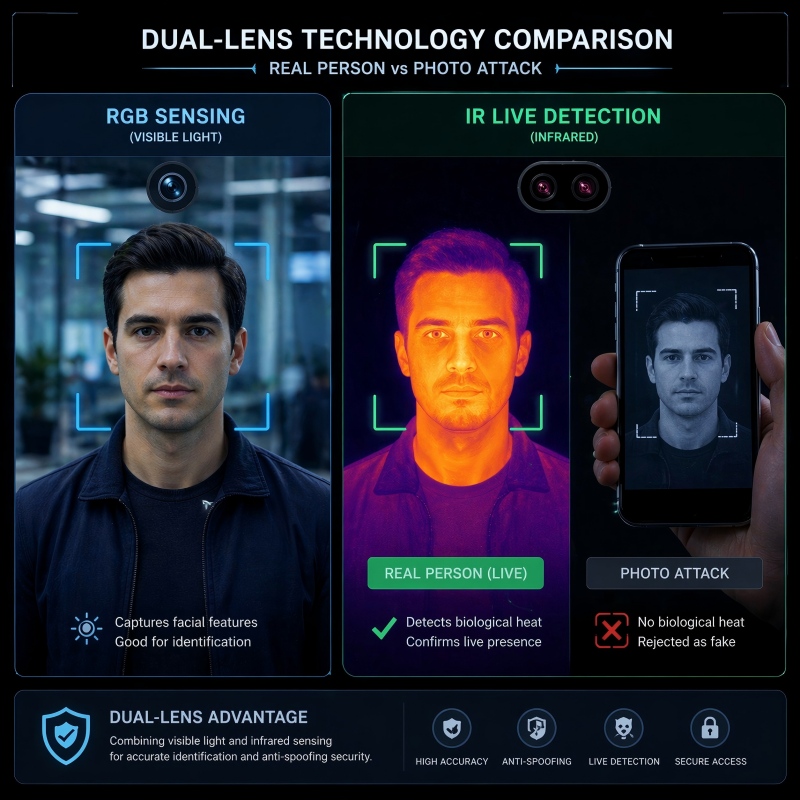
As an individual approaches a pedestrian turnstile, the RGB camera captures high-definition color and texture data of the face for identity verification. Simultaneously, the IR camera illuminates the subject with near-infrared light to analyze the characteristics of the reflected light waves. Since there is a significant disparity in infrared reflectivity between genuine human skin and materials such as paper, screens, or silicone, the underlying algorithms can instantly detect and expose spoofing attempts.
This hardware-based anti-spoofing solution—when integrated with our AI edge computing terminals—achieves a defense success rate of up to 99.9%. Even if an attacker employs an extremely lifelike 3D-printed mask, its material properties lack the light-scattering characteristics inherent to human skin; consequently, it stands no chance of evading detection by our infrared algorithms.
Edge Computing: The Perfect Balance of Security and Efficiency
Edge computing enhances real-time detection. In security-sensitive environments—such as factory Lockout/Tagout (LOTO) procedures—the processing speed of “Live Detection” directly impacts production efficiency. If the system were required to upload every data frame to the cloud for analysis, it would not only introduce risks of privacy breaches but also result in unacceptable latency.
Cheyuansu’s facial recognition terminals feature integrated high-performance NPUs, enabling the execution of all anti-spoofing computations directly at the edge. This means that all biometric analysis is performed locally. This architecture not only ensures a response time of under 300 milliseconds but—more importantly—continues to provide uncompromised security protection even in extreme scenarios involving network outages, thereby ensuring that only authorized, “real” technicians are granted access to maintenance areas.
Industry Applications: Why Does Industrial Safety Demand More Robust Live Detection?
In the context of smart campus management platforms or smart elderly care projects, Live Detection often serves primarily to ensure the accuracy of attendance tracking; however, within the realm of factory automation safety management, it is a matter of life and death.
Consider this scenario: an unauthorized individual attempts to “trick” an access control system—using a photograph of a technical supervisor—to gain entry into an active high-voltage power maintenance zone. If the system lacks robust anti-spoofing capabilities, the consequences could be catastrophic. Cheyuesu’s systems utilize relay signal interlocks to directly link the results of Live Detection with the power supply status of the equipment. Only after confirming that the operator is a qualified “verified human presence” on-site will the system authorize the execution of lockout/tagout procedures or power restoration operations.
You are invited to visit our Company Profile to learn more about the technical expertise we have cultivated since 2004, or to browse our Face Recognition Terminal Product Catalog to find the hardware solution best suited to your specific security requirements.
Continuous Evolution: Large AI Models and Generative Adversarial Networks
With the rise of Generative AI (AIGC) and Deepfake technologies, the field of anti-spoofing faces unprecedented challenges. Today’s forged videos are capable of generating highly realistic actions—such as blinking and mouth movements—in real time.
In response, Cheyuansu is fully embarking on a research and development phase centered on large AI models. We utilize Generative Adversarial Networks (GANs) to simulate millions of attack samples, thereby training Live Detection models that are more robust and forward-looking. This “AI-versus-AI” strategy ensures that our system maintains its technological leadership for years to come.
In accordance with international standards—such as ISO/IEC 30107 (https://www.iso.org/standard/67381.html)—performance testing for biometric systems must include the capability to detect various forms of Presentation Attacks. Cheyuansu remains steadfast in its commitment to upholding the highest standards of compliance, providing our clients with a trustworthy and secure foundational platform.
FAQ: Expert Answers on Live Detection and Anti-spoofing
Does wearing a face mask or safety goggles affect the accuracy of Live Detection?
No, it does not. Cheyuesu’s deep learning algorithms were trained using an extensive dataset of industrial scenarios featuring individuals wearing masks, goggles, and hard hats. Our Live Detection system primarily focuses on the periorbital region, forehead textures, and infrared reflection characteristics—areas that provide sufficient biometric signals for identification even when protective gear is being worn.
Why is an Infrared (IR) camera essential for Anti-spoofing?
While purely RGB-based algorithms can perform preliminary anti-spoofing by analyzing texture details, their false rejection rate rises significantly when confronted with 4K video playback on high-definition screens. IR cameras, which rely on the physical reflection properties of materials (rather than purely visual characteristics), are currently recognized as the most cost-effective and robust hardware solution for preventing attacks involving photos or screen displays.
Do extreme environmental temperature fluctuations (such as severe cold or intense heat) affect Live Detection?
Our industrial-grade facial recognition terminals have undergone rigorous environmental reliability testing. Although temperature variations can alter an object’s thermal radiation, our multi-spectral fusion algorithms do not rely solely on thermal readings; instead, they integrate image textures with light-wave reflection models. Consequently, Live Detection maintains a high level of stability and performance, even in northern factories where temperatures drop as low as -20°C.
Does this technology have any implications for user privacy?
The Live Detection process involves the real-time processing of raw optical signals at the edge (locally); the system does not need to store this sensitive physiological fluctuation data. Once identification is complete, the system retains only the anonymized feature codes required for matching purposes. This localized processing architecture complies with major global data privacy regulations, such as the GDPR.
In today’s pursuit of uncompromising security and efficiency, Live Detection and Anti-spoofing are no longer costly add-ons, but rather standard features in every professional security system.
Leveraging two decades of deep expertise in visual algorithms, Shenzhen Cheyuansu Industrial Co., Ltd. brings this level of financial-grade defensive capability to the vital—yet often overlooked—industrial workplace. From the nascent stages of algorithm development in 2004 to the AI Large Model-driven capabilities of 2026, we have always firmly believed that technological advancement should make security simpler and more seamless.
If you are seeking a facial recognition access control system with robust anti-spoofing capabilities, or wish to integrate a higher level of biometric security verification into your existing factory automation management, please explore our AI Intelligent Series products or contact our technical experts for a customized solution.