Modern construction projects are becoming larger, more complex, and increasingly dependent on intelligent safety management systems. Construction companies worldwide are under growing pressure to reduce workplace accidents, improve compliance management, and strengthen worker protection.
Traditional construction site supervision methods often rely heavily on manual inspections and human observation. However, these methods may not provide real-time visibility across large and dynamic work environments.
As smart construction technology continues to evolve, many companies are now adopting AI helmet detection systems to automate safety monitoring and improve construction site compliance.
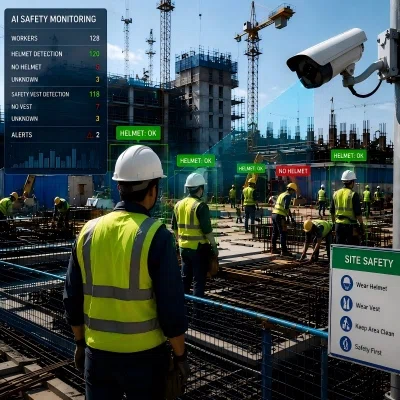
Helmet detection AI uses computer vision, deep learning, and intelligent video analytics to identify whether workers are wearing protective helmets correctly. These systems can continuously monitor construction areas and immediately trigger alerts when violations are detected.
Compared with traditional manual inspections, AI construction safety systems provide faster response times, higher monitoring efficiency, and more accurate safety compliance management.
Companies interested in broader AI visual recognition technologies can also explore NewAutoT’s intelligent security solutions:https://newautot.com/
Why Construction Sites Need AI Helmet Detection Systems
Construction sites remain one of the highest-risk work environments in the world.
Workers often face dangers such as:
- Falling objects
- Heavy machinery accidents
- Unsafe operating behavior
- Restricted area access
- Poor visibility environments
Safety helmets are one of the most important forms of personal protective equipment because they reduce the risk of head injuries.
However, maintaining helmet compliance across large construction sites is difficult using only manual supervision.
Many construction companies now integrate AI helmet detection systems with existing PPE detection systems to improve worker safety monitoring efficiency.
For example, smart construction sites may combine:
- AI helmet detection
- Facial recognition access control systems
- Worker attendance platforms
- Construction site surveillance systems
- AI worker safety monitoring solutions
This creates a more intelligent and connected construction safety ecosystem.
Construction companies exploring smart worker management solutions can also read:
“PPE Detection System for Construction Sites: How AI Improves Worker Safety and Compliance”
This related topic helps strengthen overall smart construction safety management.
According to the Occupational Safety and Health Administration (OSHA), proper PPE management remains one of the most effective methods for reducing workplace injuries:
https://www.osha.gov/personal-protective-equipment
How AI Helmet Detection Systems Work
AI helmet detection systems use advanced computer vision technology to analyze live video streams captured by smart surveillance cameras.
The process generally includes several stages.
Video Capture
High-definition cameras continuously monitor construction zones and worker activity.
AI Image Analysis
Computer vision algorithms automatically identify:
- Workers
- Safety helmets
- Reflective safety vests
- Worker movement
- Restricted area violations
Compliance Verification
The system compares visual information against predefined safety rules.
For example:
- Helmet required zones
- Restricted work areas
- High-risk equipment zones
Real-Time Alerts
If a worker enters a dangerous area without a helmet, the AI construction safety system can:
- Trigger instant alerts
- Notify safety managers
- Save incident footage
- Generate compliance reports
- Activate warning systems
This allows construction companies to improve real-time construction safety monitoring.
Businesses interested in AI surveillance technologies can also learn more from IBM’s overview of computer vision:
https://www.ibm.com/topics/computer-vision
Benefits of AI Helmet Detection Systems
Improved Worker Safety
The primary benefit of helmet detection AI is reducing workplace injury risks.
AI surveillance systems can continuously monitor multiple construction areas without fatigue.
Unlike manual inspections, AI systems can operate 24/7.
This helps construction companies identify safety violations immediately.
Faster Incident Response
Traditional safety supervision may take time to identify violations.
AI construction safety monitoring systems can send alerts instantly.
This allows supervisors to intervene before accidents occur.
Lower Safety Management Costs
Large construction projects require significant labor resources for safety inspections.
AI worker safety monitoring systems help reduce repetitive manual supervision tasks.
Better Compliance Documentation
Construction companies often need digital compliance records for audits and insurance purposes.
Helmet detection AI systems can automatically generate:
- Safety reports
- Violation logs
- Video evidence
- Worker compliance records
Improved Smart Construction Management
Modern smart construction sites increasingly combine:
- AI surveillance systems
- Smart access control
- Worker attendance systems
- Edge AI computing
- Construction analytics
Helmet detection systems become a core part of this intelligent ecosystem.
AI Helmet Detection and Smart Construction Sites
The construction industry is moving rapidly toward digital transformation.
Smart construction sites now use AI technologies to improve:
- Worker safety
- Attendance management
- Access control
- Equipment monitoring
- Operational efficiency
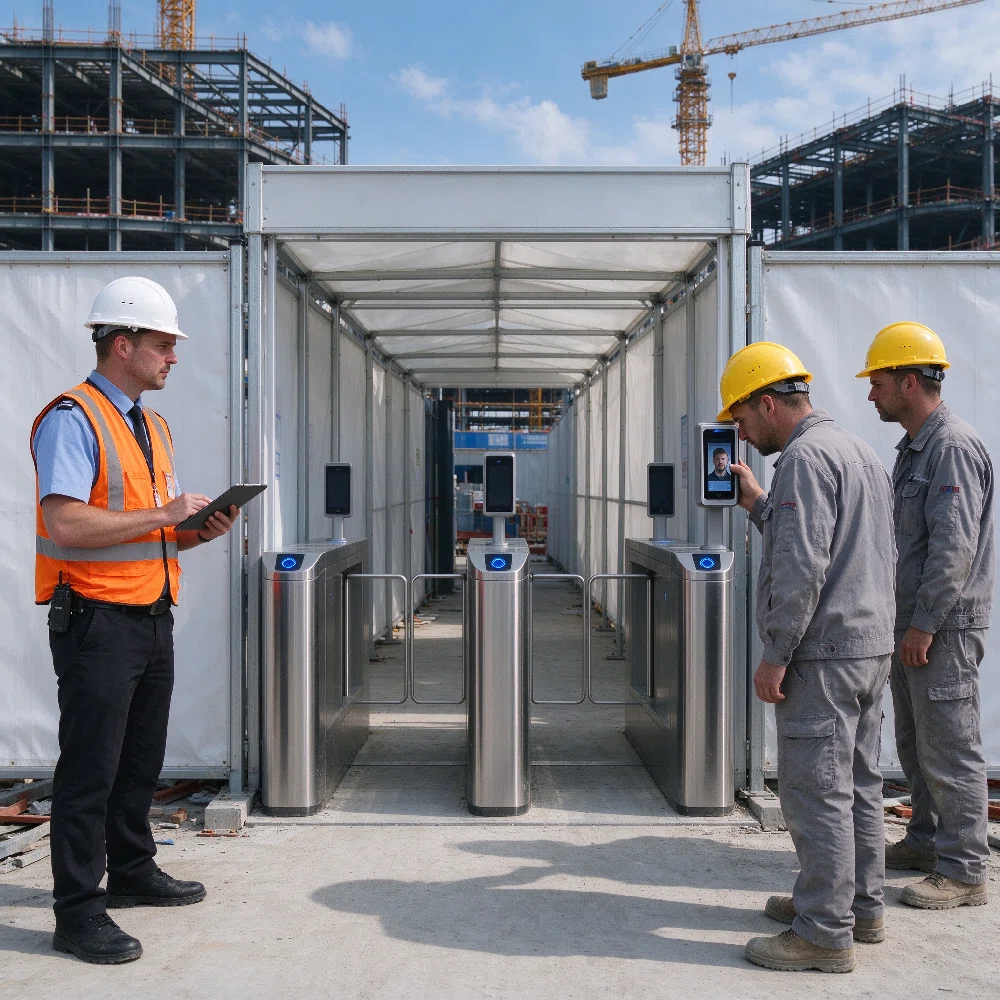
Many companies integrate helmet detection AI with facial recognition access control systems to create more advanced safety management platforms.
For example, workers may only be allowed to enter dangerous construction zones when:
- Their identity is verified
- Proper PPE is detected
- Attendance records are validated
This combination significantly improves restricted area security.
Construction companies implementing intelligent worker management systems may also benefit from:
- AI worker safety monitoring
- Construction site attendance systems
- Smart construction access control
- PPE detection systems
These interconnected technologies help create a complete smart construction solution.
Edge AI in Construction Safety Monitoring
Edge AI technology is becoming increasingly important in modern construction surveillance systems.
Traditional cloud-based monitoring platforms may experience network latency or unstable connectivity.
Edge AI devices process video data locally near surveillance cameras.
This provides several advantages:
- Faster response times
- Reduced bandwidth usage
- Improved privacy protection
- Stable offline operation
- Real-time safety analysis
Many AI construction safety systems now combine edge AI computing with helmet detection AI to improve monitoring performance.
Businesses interested in industrial edge computing technologies can also explore related NewAutoT solutions.
Industries Using AI Helmet Detection Systems
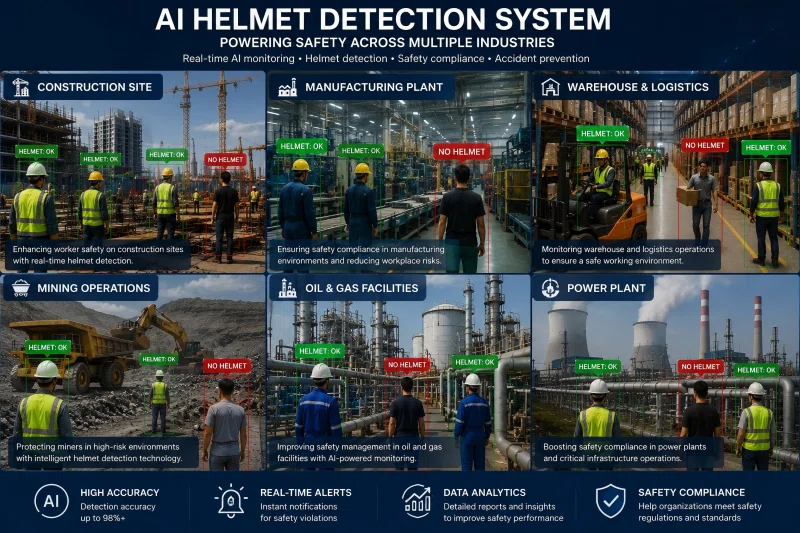
Although construction is one of the largest applications, helmet detection AI is also widely used in:
Manufacturing Plants
Factories use AI safety monitoring systems to protect workers operating heavy machinery.
Warehouses and Logistics Centers
Warehouse operators use smart surveillance systems to improve loading zone safety.
Mining Sites
Mining companies use helmet detection AI in high-risk underground environments.
Oil and Gas Facilities
Industrial energy facilities use AI surveillance technology to strengthen safety compliance.
Smart Industrial Parks
Industrial parks increasingly integrate AI visual recognition systems with access control and visitor management platforms.
According to the National Safety Council (NSC), workplace safety technology is becoming increasingly important across industrial environments:
https://www.nsc.org/work-safety/safety-topics/construction-safety
Future Trends in AI Construction Safety
The future of construction safety management will become increasingly intelligent.
Emerging trends include:
- AI behavior prediction
- Autonomous construction drones
- Wearable safety devices
- Smart worker positioning systems
- Digital twin construction management
- AI robotics integration
As computer vision technology continues to improve, AI helmet detection systems will become even more accurate and efficient.
Construction companies adopting these technologies early may gain significant operational and safety advantages.
Conclusion
AI helmet detection systems are transforming construction safety management through intelligent automation and real-time monitoring.
Compared with traditional manual inspections, AI construction safety systems provide:
- Faster safety response
- Improved worker protection
- Better compliance management
- Lower supervision costs
- Smarter construction site operations
As smart construction technology continues to evolve, helmet detection AI will become an increasingly important part of modern workplace safety management.
Construction companies seeking advanced AI visual recognition technologies should consider integrating:
- PPE detection systems
- AI worker safety monitoring
- Facial recognition access control
- Smart surveillance systems
- Edge AI computing
Together, these technologies create a more intelligent and safer construction environment.
To learn more about AI-powered visual recognition and construction safety technologies, visit:https://newautot.com/
FAQ
What is an AI helmet detection system?
An AI helmet detection system uses computer vision and AI surveillance cameras to identify whether workers are wearing safety helmets correctly.
Can AI helmet detection systems work in real time?
Yes. Most systems provide real-time monitoring and instant alerts.
What industries use helmet detection AI?
Construction, manufacturing, mining, warehouses, and oil & gas industries widely use AI helmet detection systems.
Can AI helmet detection integrate with access control systems?
Yes. Many systems integrate with facial recognition access control and attendance platforms.
What are the benefits of AI helmet detection systems?
They improve worker safety, automate compliance monitoring, reduce accidents, and support smart construction management.