
Introduction
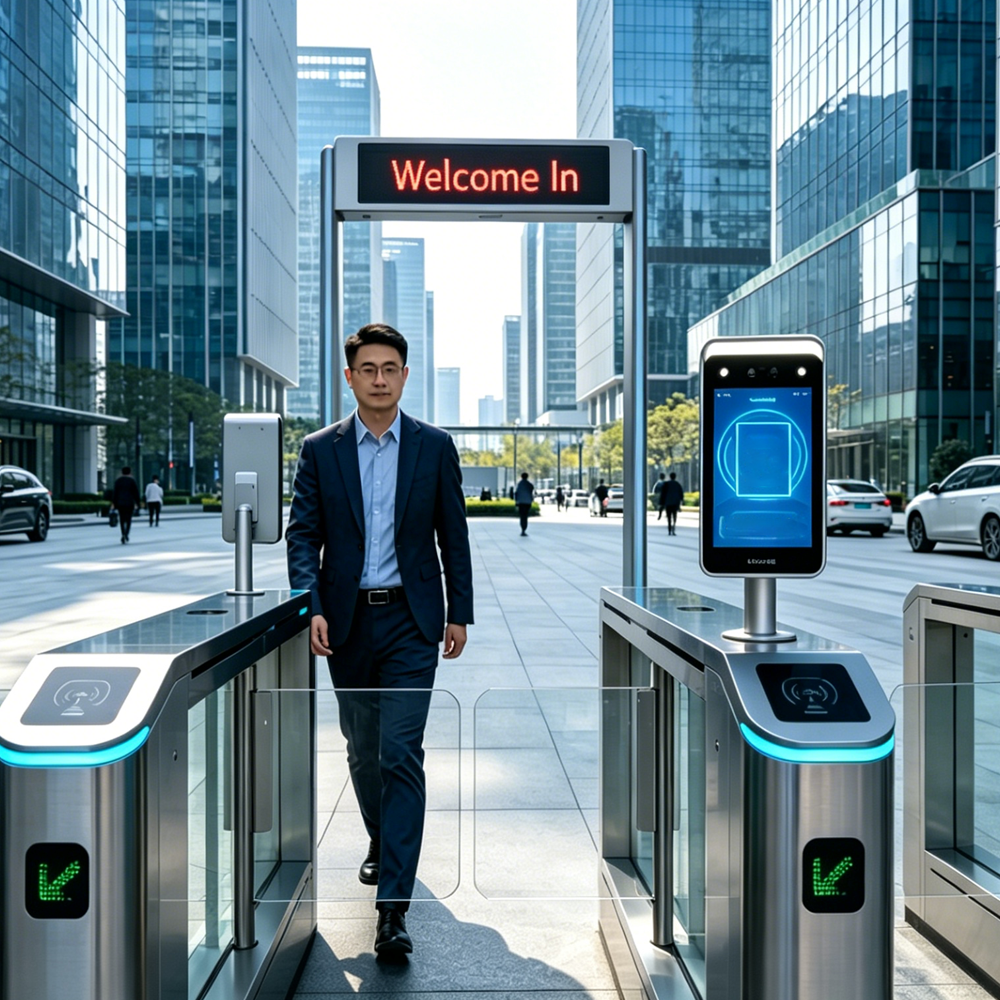
Established in 2004 and backed by two decades of dedicated research and development in visual algorithms, Shenzhen New Auto Element Industrial Co., Ltd. is a National High-tech Enterprise with deep-rooted technical expertise in navigating extreme lighting and shadow environments. From our early, in-depth collaborations with Mobileye—a global pioneer in visual processing—to our development of sophisticated Advanced Driver-Assistance Systems (ADAS), we have amassed extensive experience in image processing within scenarios characterized by high-speed motion and rapidly shifting light conditions. This wealth of technical expertise has now been seamlessly translated into the core competitive advantage of our outdoor facial recognition terminals.
What is WDR Technology? (Wide Dynamic Range)
WDR (Wide Dynamic Range) technology is a crucial tool for enhancing the performance of outdoor facial recognition, as it effectively mitigates the impact of lighting conditions on image quality. Understanding What is WDR technology and why is it important for outdoor face recognition is essential for leveraging its benefits. Furthermore, WDR technology can significantly improve the accuracy of facial recognition under complex lighting conditions.
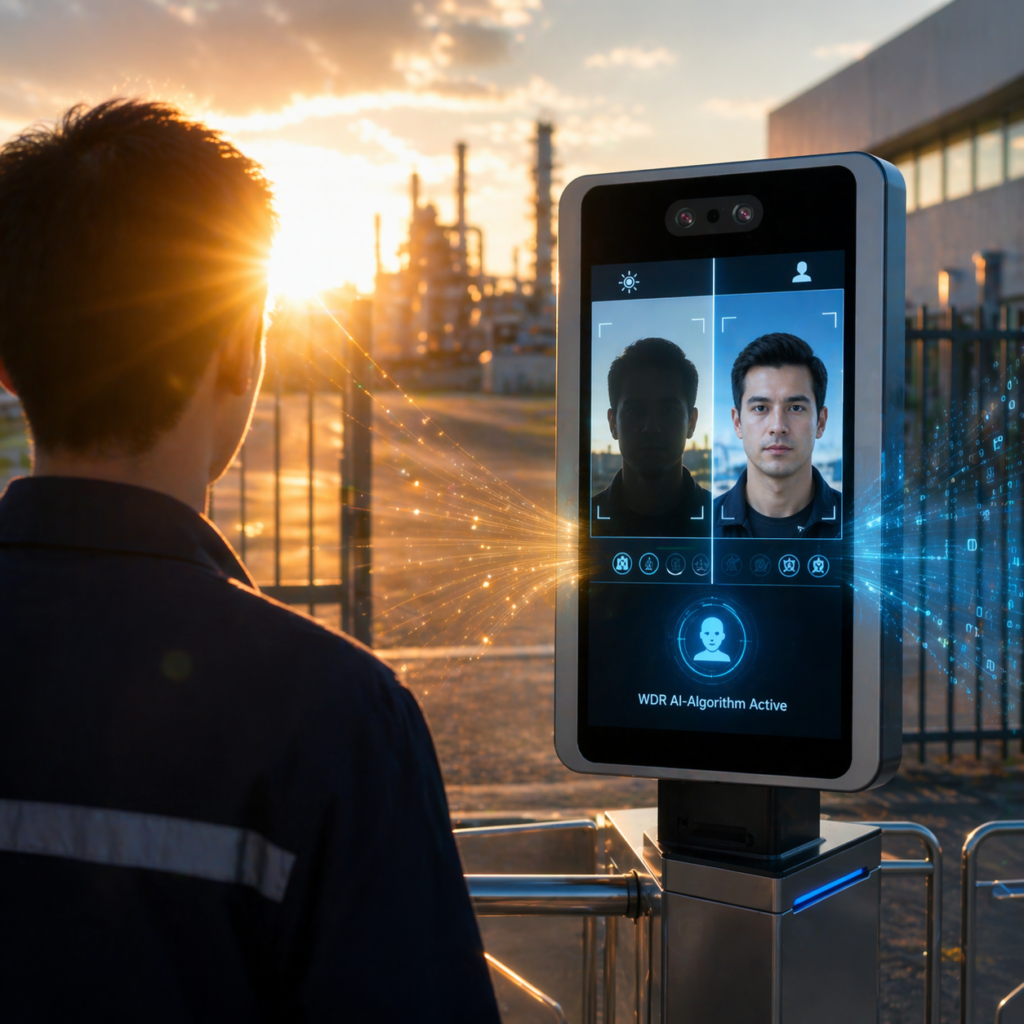
Wide Dynamic Range technology—abbreviated as WDR—aims primarily to enable a camera to capture details in both shadow and highlight areas, even within environments characterized by extreme contrast. During the image sensor’s processing workflow, when a single scene contains both intensely bright areas (such as direct sunlight) and extremely dim areas (such as the shaded side of a building), standard sensors are often forced to make a choice: either allow the bright areas to become overexposed (resulting in a washed-out white expanse) or allow the dark areas to become completely underexposed (resulting in a solid mass of black).
The underlying principle of WDR technology typically involves “multiple exposure stacking.” The sensor captures multiple image frames within a very brief timeframe using varying shutter speeds—one frame to capture details in the dark areas, and another to capture details in the bright areas. These frames are then fused into a single cohesive image through the combined efforts of a high-speed Image Signal Processor (ISP) and sophisticated visual algorithms. The resulting output preserves the subtle gradations of clouds in the sky while simultaneously allowing for the clear identification of facial features within the shadows.
like:
👉
Why is it Crucial for Outdoor Face Recognition?
WDR is widely used in outdoor environments(face-recognition-gate-construction-site-safety-guide). In indoor environments, lighting is typically controlled and uniform. Outdoors, however, the environment is unpredictable. The key to understanding “What is WDR technology, and why is it important for outdoor face recognition?” lies in the concept of recognition “certainty.”
1.Identity Verification in Backlit Environments
At factory entrances or office building lobbies, sunlight frequently streams into the camera lens from behind pedestrians. In such strong backlit scenarios, devices lacking WDR technology capture nothing more than a pitch-black silhouette. For face recognition algorithms, the absence of key facial feature points spells recognition failure; this forces employees to repeatedly adjust their posture in front of turnstiles—drastically reducing throughput efficiency and potentially creating security vulnerabilities.
2.Interference from Harsh Shadows and Light Patches
In the summer, shadows cast by trees or the sharp angles of buildings can create uneven “light patches” across a person’s face. These patches interfere with the algorithm’s ability to accurately analyze skeletal structure and skin texture. By utilizing a system equipped with High Dynamic Range (HDR) capabilities, facial lighting can be smoothed out, ensuring that the backend Face Recognition System (Internal Link) captures the most authentic biometric data possible.
3.Stability in All-Weather Operation
From the first light of dawn to the blazing sun at noon, and finally to the lingering glow of dusk, the color temperature and intensity of ambient light are in constant flux. Leveraging a wealth of visual algorithm expertise accumulated since 2004, Cheyuansu has achieved “financial-grade” standards in ISP (Image Signal Processing) tuning. We firmly believe that an exceptional suite of AI Intelligent Products (Internal Link) must be capable of delivering a consistent recognition experience under any weather condition.
Cheyuansu’s 20-Year Visual Heritage: From ADAS to Intelligent Access Control
Why does Cheyuansu possess a distinct advantage in handling Wide Dynamic Range (WDR) challenges? The answer lies within our history of development.
In 2009, we embarked on a deep collaboration with Mobileye. In the realm of autonomous driving, vehicles must—in mere milliseconds—navigate through tunnels characterized by rapid shifts between extreme brightness and darkness, or accurately identify road obstacles while driving directly into the setting sun. These exacting demands regarding the processing of light and shadow forged the exceptional robustness of our algorithms.
When we ported these automotive-grade visual algorithms to pedestrian access control terminals, we discovered that many obstacles—which remain formidable challenges in the general security sector—already had ready-made solutions within our existing technical framework. We focus not merely on the numerical dynamic range (dB) of the sensors; rather, we prioritize the secondary enhancement of images through AI deep learning algorithms, thereby ensuring that identity verification remains rock-solid—even amidst the complex interplay of light and shadow found in industrial production environments.
Technology Selection Advice: True WDR vs. Digital WDR
When seeking the answer to the question, “What is WDR technology and why is it important for outdoor face recognition?”, buyers must be mindful of the distinction between “Digital WDR (DWDR)” and “Hardware WDR (True WDR).”
Digital WDR (DWDR): Primarily relies on post-processing software to boost the brightness of dark areas; this approach often generates significant image noise and frequently struggles to meet professional-grade requirements for recognition accuracy.
Hardware WDR (True WDR): Achieved through the sensor’s inherent multi-exposure capabilities, resulting in images that are clear, true-to-life, and low in noise. All professional-grade terminals from Cheyuansu feature True WDR technology with a dynamic range of 120dB or higher, thereby meeting the rigorous specifications established by the International Organization for Standardization (ISO) regarding biometric data acquisition environments.
Business Value: Beyond Clarity—It’s About Efficiency
For corporate management, the business rationale behind deploying facial recognition terminals equipped with WDR technology lies in the enhancement of Return on Investment (ROI):
Reduced Manual Intervention: Eliminates instances where security personnel must manually open doors due to failed recognition attempts.
Enhanced Employee Satisfaction: Enables seamless, near-instantaneous access, thereby elevating the corporate image.
Strengthened Security: Prevents attackers from disrupting recognition systems by shining bright lights into the camera, thereby reinforcing the integrity of the Industrial Security Management closed-loop system.
You may refer to research on Wide Dynamic Range processing in computer vision available on IEEE Xplore to gain further insight into this technology’s leading global position.
FAQ: Expert Answers on WDR and Outdoor Recognition
Since WDR is available, why is IR illumination still necessary?
WDR addresses issues related to high contrast between bright and dark areas, whereas IR illumination solves the problem of “total absence of light.” In a factory environment late at night, WDR technology—when combined with supplementary lighting—ensures that recognition accuracy remains above 99.9%.
Is a higher Wide Dynamic Range (WDR) value (dB) always better?
Theoretically, yes. Standard cameras may only offer 60–70 dB, whereas professional outdoor facial recognition terminals typically require a range of 100–120 dB—or even higher—to maintain image clarity under direct sunlight.
Can the installation location serve as a substitute for WDR?
Adjusting the installation position (e.g., avoiding direct exposure to sunlight) can alleviate some of the strain; however, it cannot completely eliminate the effects of diffuse reflection and seasonal variations in lighting and shadows. WDR is a fundamental, “essential” technology for any outdoor recognition system.
Does this technology impact the device’s lifespan?
True WDR necessitates high-frequency image processing, which places significant demands on the main chip’s computing power and thermal management capabilities. Cheyuansu terminals utilize industrial-grade PCBA manufacturing processes to ensure stable operation for 5 to 8 years or more, even under continuous, high-load computing conditions.
Understanding “What is WDR technology, and why is it important for outdoor facial recognition?” is the first step toward building a modern smart factory. In an era where lighting conditions and shadows shift in an instant, standalone hardware is no longer sufficient to meet complex security demands.
Leveraging two decades of expertise in visual algorithms, Shenzhen Cheyuansu Industrial Co., Ltd. has adapted high-end vision technologies—originally developed for autonomous driving—to ensure a “crystal-clear image” of every employee passing through your access gates. We do not merely manufacture hardware; we apply 20 years of professional dedication to safeguard the security hidden within every interplay of light and shadow.
If you are seeking a highly reliable identity verification solution for your outdoor premises, we invite you to browse our catalog of AI Smart Terminals or contact our technical experts directly to receive a customized analysis report tailored to your specific on-site lighting conditions.