As digital transformation deepens, standalone, standardized smart devices are increasingly struggling to meet the demands of complex and ever-more-personalized security and management scenarios. Particularly within the B2B sector, many procurement decision-makers, system integrators, and brand owners are now seeking highly customizable OEM/ODM facial recognition terminals. They are not merely looking for a piece of hardware; rather, they are seeking a comprehensive solution capable of seamlessly integrating into their existing ecosystems, boosting operational efficiency, and enhancing security.
As a National High-Tech Enterprise dedicated to the fundamental R&D of computer vision algorithms for two decades (since 2004), Shenzhen New Auto Element Industrial Co., Ltd. possesses a deep technological moat in handling extreme industrial environments and ensuring highly reliable identity verification. We fully understand that an exceptional OEM/ODM facial recognition terminal requires not only a durable “body” but also an intelligent “brain”—and this is precisely where New Auto Element’s core strength lies. This article will provide a comprehensive breakdown of the customization strategies for OEM/ODM facial recognition terminals, empowering you to make informed decisions.
OEM vs. ODM: Two Paths in Customizing Facial Recognition Terminals
Before embarking on a customization journey, it is crucial to clearly understand the distinction between OEM (Original Equipment Manufacturer) and ODM (Original Design Manufacturer) within the realm of facial recognition technology. This distinction will determine the depth of collaboration and the level of resource investment required for your OEM/ODM facial recognition terminal project:
OEM (Original Equipment Manufacturing): Typically applicable when you already possess a mature hardware design (or choose to utilize our company’s established standard hardware molds). Under this model, we deploy your proprietary algorithms onto the terminals, affix your brand logo, and handle the production and packaging processes in strict accordance with your specific standards. For instance, a large-scale security system integrator might simply require Cheyuesu to supply high-performance hardware, while they independently handle the software integration and branding aspects.
ODM (Original Design Manufacturing): Represents a deeper level of collaboration. You need only outline your functional requirements, intended application scenarios, or brand design concepts; the entire end-to-end process—ranging from exterior design, mold development, and circuit board design to operating system optimization and core algorithm deployment (such as utilizing Cheyuesu’s proprietary algorithms)—is executed entirely by the Cheyuesu team. This type of collaboration is typically suited for brands seeking to launch a comprehensive line of OEM/ODM facial recognition terminal products that possess unique competitive advantages.
Core Advantages: Why Does Your Business Need OEM/ODM Facial Recognition Terminal Services?
When evaluating the costs associated with OEM/ODM facial recognition terminals, it is essential to view them through the lens of “Return on Investment” (ROI). Customization services are not merely about brand identity; they are fundamentally about core efficiency and security:
- Rapid Market Penetration (Time-to-Market)
Developing a high-performance facial recognition terminal in-house typically requires 18 to 24 months—or even longer. By selecting a mature OEM/ODM partner for facial recognition terminals, you can drastically shorten this development cycle. Cheyuansu possesses a mature hardware supply chain as well as extensive, ready-to-deploy expertise in ISP (Image Signal Processing) and NPU (Neural Processing Unit) optimization. This allows us to compress the project timeline to just 3 to 6 months, empowering you to capture market share rapidly. - Financial-Grade and Industrial-Grade Security Standards
Security is the lifeline of any facial recognition system. Our core vision algorithms have undergone numerous iterations since 2004, evolving far beyond simple 2D photo matching. We now employ 3D liveness detection (anti-spoofing) technology based on binocular fusion and near-infrared imaging, effectively filtering out fraudulent attacks involving photos, videos, and highly realistic masks. You can visit IEEE Xplore to explore the latest research regarding Wide Dynamic Range (WDR) technology and biometric defense capabilities. Integrating financial-grade security into your OEM/ODM facial recognition terminals is our standard practice. - Automotive-Grade ISP Expertise and All-Weather Outdoor Adaptability
Many outdoor environments—such as factory gates, port terminals, and smart campuses—present extremely challenging lighting conditions where standard cameras often fail under backlighting, intense glare, or extremely low-light scenarios. Cheyuansu’s core vision algorithms are rooted in our deep, accumulated expertise within the fields of ADAS (Advanced Driver-Assistance Systems) and DMS (Driver Monitoring Systems). Through early-stage, in-depth collaborations with the global industry leader Mobileye (Israel), we have amassed a massive dataset regarding the processing of complex lighting and shadow conditions. This “automotive-grade ISP optimization capability” ensures that our OEM/ODM facial recognition terminals maintain millisecond-level recognition accuracy, even in the most rigorous outdoor environments.
How to Build the Ideal OEM/ODM Facial Recognition Terminal?
Understanding hardware selection helps in choosing the right supplier. To build a competitive OEM/ODM facial recognition terminal for the market, buyers must evaluate and customize the product across three key dimensions: hardware reliability, algorithmic sophistication, and system integration.
Hardware Reliability: Beyond Just IP65
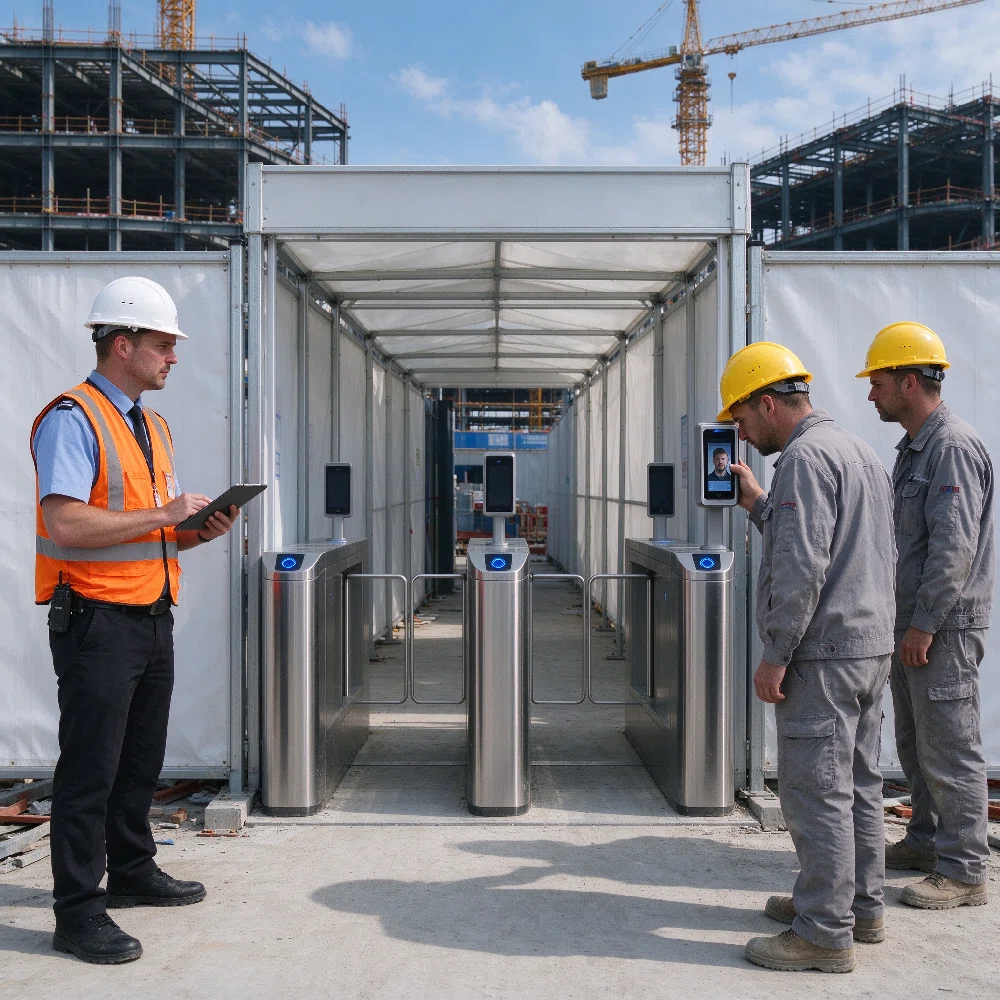
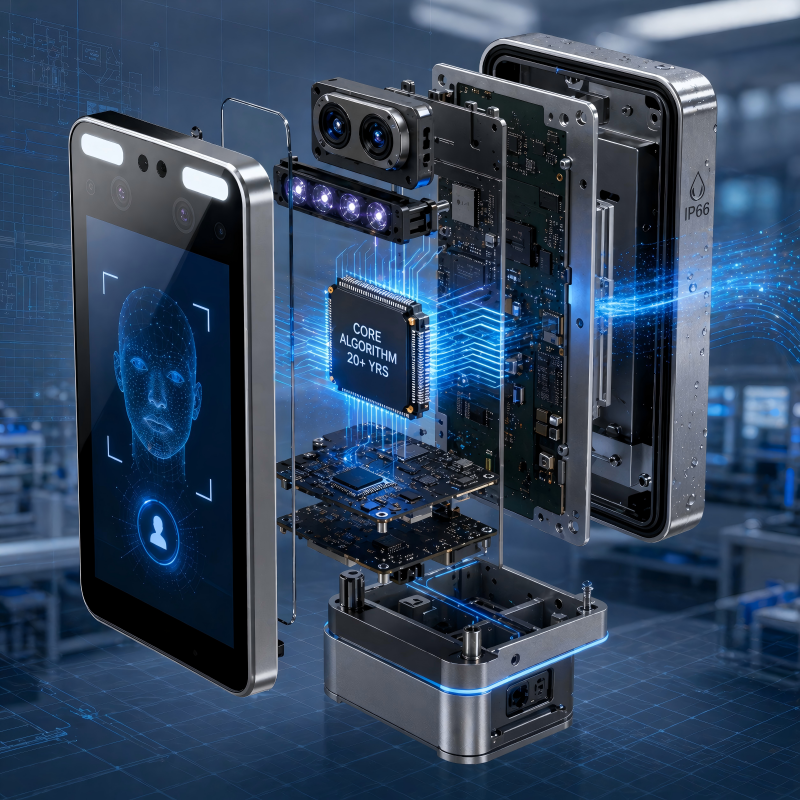
If your terminal is deployed in an industrial setting—such as for access control at a chemical plant—it will face challenges ranging from high temperatures and dust to chemical corrosion. When customizing an OEM/ODM facial recognition terminal, it is crucial to focus not only on dynamic range (dB) and NPU computing power (TOPS) but also, and perhaps more importantly, on physical durability. We recommend utilizing SUS304 stainless steel construction and protective enclosures rated at IP66 or IK08. Cheyuansu terminals undergo rigorous environmental testing to ensure stable, round-the-clock operation across a wide temperature range—from -20°C to +70°C—thereby reducing your long-term maintenance costs.
Algorithmic Sophistication: The Core Moat
The true quality of an OEM/ODM facial recognition terminal is often determined by the depth and maturity of its underlying code. Cheyuansu’s algorithms leverage deep learning AI networks to train robust models capable of handling a wide variety of complex scenarios. We believe that an exceptional algorithm must do more than merely “see clearly”—it must “verify authentically.” This includes:
Extreme Lighting and Shadow Handling: Whether facing the momentary glare of welding sparks or the ultra-low illumination of a late-night warehouse, our technology—utilizing Wide Dynamic Range (WDR) and automotive-grade ISP tuning—ensures flawless verification coverage with zero blind spots.
Recognition with Protective Gear: In industrial environments where workers are required to wear safety helmets and face masks, our algorithms can accurately identify individuals and verify compliance without requiring the removal of protective equipment.
Edge Computing Capabilities: All biometric analysis is performed locally on the device, ensuring millisecond-level response times and maintaining secure, reliable operation even in the event of a network outage.
If you are seeking a solution for high-security environments, we invite you to consult the definitions for Liveness Detection Technology outlined in the ISO/IEC 30107 standard to understand international best practices regarding the detection of Presentation Attacks.
System Integration: Enabling Closed-Loop Logic
Verification in isolation is meaningless; the true objective lies in deeply integrating verification results with core business logic. When procuring custom OEM/ODM facial recognition terminals, buyers should prioritize evaluating the system’s scalability. A robust system must offer not only high-performance hardware but also a comprehensive suite of SDKs and API interfaces. For instance, in smart facility management, we link the results of liveness detection to equipment power supply and Lockout-Tagout (LOTO) statuses. The system permits the execution of tag removal procedures only after confirming that the operator is a qualified “verified human presence” on-site—thereby effectively enhancing the security of the Smart Factory Management System.
B2B Procurement Guide: Key Dimensions for Partner Selection
When seeking a trustworthy OEM/ODM partner for facial recognition terminals, two core considerations stand out: their depth of technological expertise and their capabilities in full lifecycle management.
Algorithm Pedigree: Select a partner that has specialized in visual image processing since 2004 and possesses a track record of collaboration with global industry leaders, such as Mobileye.
Hardware Reliability: Verify that the terminal casing is constructed from high-grade materials—such as SUS304 stainless steel—and has successfully passed rigorous testing under extreme environmental conditions.
Customization: Evaluate their end-to-end customization capabilities, ranging from ISP tuning, NPU computing modules, and external sensors to the underlying software architecture.
Compliance: Ensure that the algorithms adhere to international data privacy regulations—such as the GDPR—particularly regarding the execution of edge computing locally. Cheyuansu’s facial recognition systems are fully designed to integrate these compliance requirements, employing technical mechanisms that eliminate the need to store sensitive user data by performing all verification processes exclusively at the edge.
Support: Inquire about the technical support team’s response times and their strategy for providing firmware updates throughout the product’s entire lifecycle.
FAQ: Expert Answers Regarding OEM/ODM Facial Recognition Terminals
Is a cloud-based or local server solution more cost-effective for OEM/ODM facial recognition terminals?
It depends on the scale of the deployment. Cloud-based solutions require a lower initial investment but incur ongoing monthly subscription fees; conversely, local servers entail higher upfront costs—including the initial price of the OEM/ODM facial recognition terminals themselves (Internal Link)—but for large-scale industrial scenarios, they eliminate long-term subscription fees and offer greater control over data. Cheyuansu’s terminals feature edge NPUs with high TOPS computing power, offering the flexibility to support both architectural solutions.
How can I ensure that my customized OEM/ODM facial recognition terminals comply with the latest data privacy regulations?
Compliance is the fundamental starting point of our design process. By leveraging a core edge computing architecture, all sensitive biometric data is analyzed locally, and the system outputs only anonymized feature codes. This means that when you customize your OEM/ODM facial recognition terminals with us, you are already building upon a foundation of robust data protection. You can access privacy protection guidelines that adhere to international standards to learn more about global best practices in biometrics.
How does this system prevent fraud resulting from photo or video spoofing attacks?
The key lies in our multi-spectral fusion technology. Cheyuansu’s AI Intelligent Series products combine dual-lens RGB (visible light) and Near-Infrared (IR) cameras. Since genuine human faces possess unique infrared reflection characteristics—distinctly different from those of paper printouts or digital screens—our algorithms can instantly detect and expose spoofing attempts. This hardware-based anti-spoofing solution represents the most robust hardware-level defense against time and attendance fraud occurring at OEM/ODM facial recognition terminals.
Can these customized OEM/ODM facial recognition terminals be deployed in environments with extreme heat or severe cold?
Absolutely. By combining an industrial-grade wide-temperature design with the extensive experience in extreme-environment image processing we have gained from the DMS/ADAS sectors, we integrate WDR technology, temperature compensation algorithms, and SUS304 stainless steel materials. Cheyuansu’s industrial-grade terminals ensure that identity verification remains stable and operates within milliseconds—even in extreme industrial environments ranging from -20°C to +70°C.
Understanding the intricacies of customizing OEM/ODM facial recognition terminals is the first step toward building a modern smart factory. In this new era of data-driven security, standalone hardware solutions are no longer sufficient to support complex management requirements.
If you are seeking a highly reliable identity verification solution for your outdoor facilities—or looking to develop a unique branded product—we invite you to browse our catalog of AI smart terminals to receive a customized analysis report tailored to your specific operational environment. We will assist you in elevating your security ecosystem to new heights through the implementation of high-performance, high-impact keyword strategies.