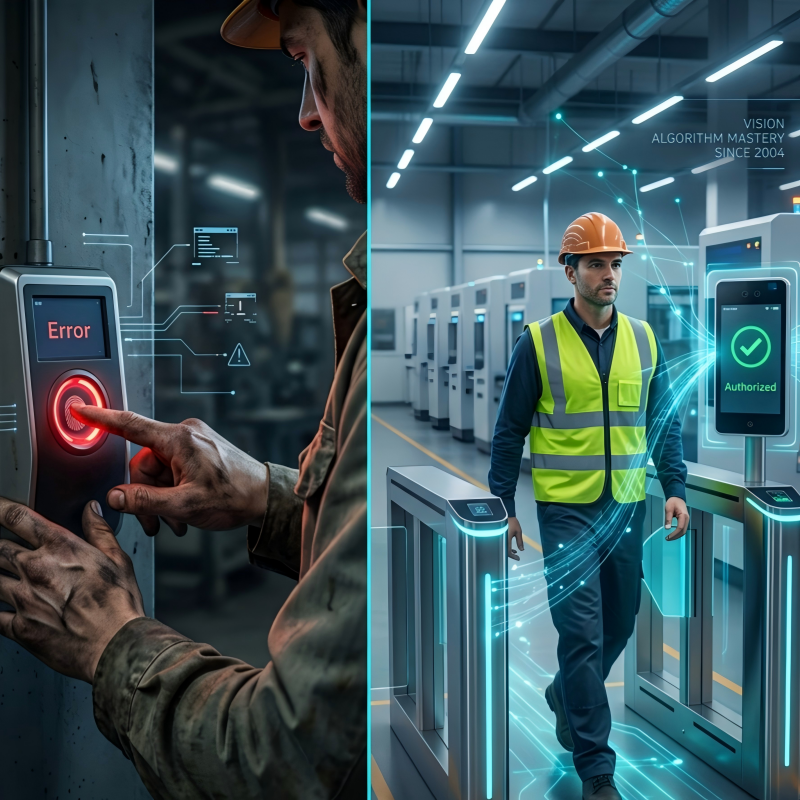
In the realm of industrial manufacturing, access management is not merely a security concern; it is a core element of production efficiency and workforce management. With the widespread adoption of the “smart factory” concept, managers upgrading their systems frequently face a classic technological dilemma: within a factory setting, which is superior—fingerprint or facial recognition for access control? Today, facial recognition access control is becoming the preferred choice for an increasing number of enterprises.
Traditional Fingerprint Recognition: The Industrial Standard of Yesteryear
For a long time, fingerprint recognition has been the preferred choice for many factories. The advantages of this choice lie in its relatively low cost and high prevalence. However, with the advancement of technology, facial recognition access control is gradually becoming the trend in modern factories.
Inherent Advantages of Fingerprint Recognition
Low Deployment Cost: For small workshops with extremely limited budgets, the hardware cost of fingerprint readers is indeed attractive.
Technological Maturity: Fingerprint recognition has been in use for decades, and managers are highly familiar with its operational logic.
Critical Flaws in Industrial Environments
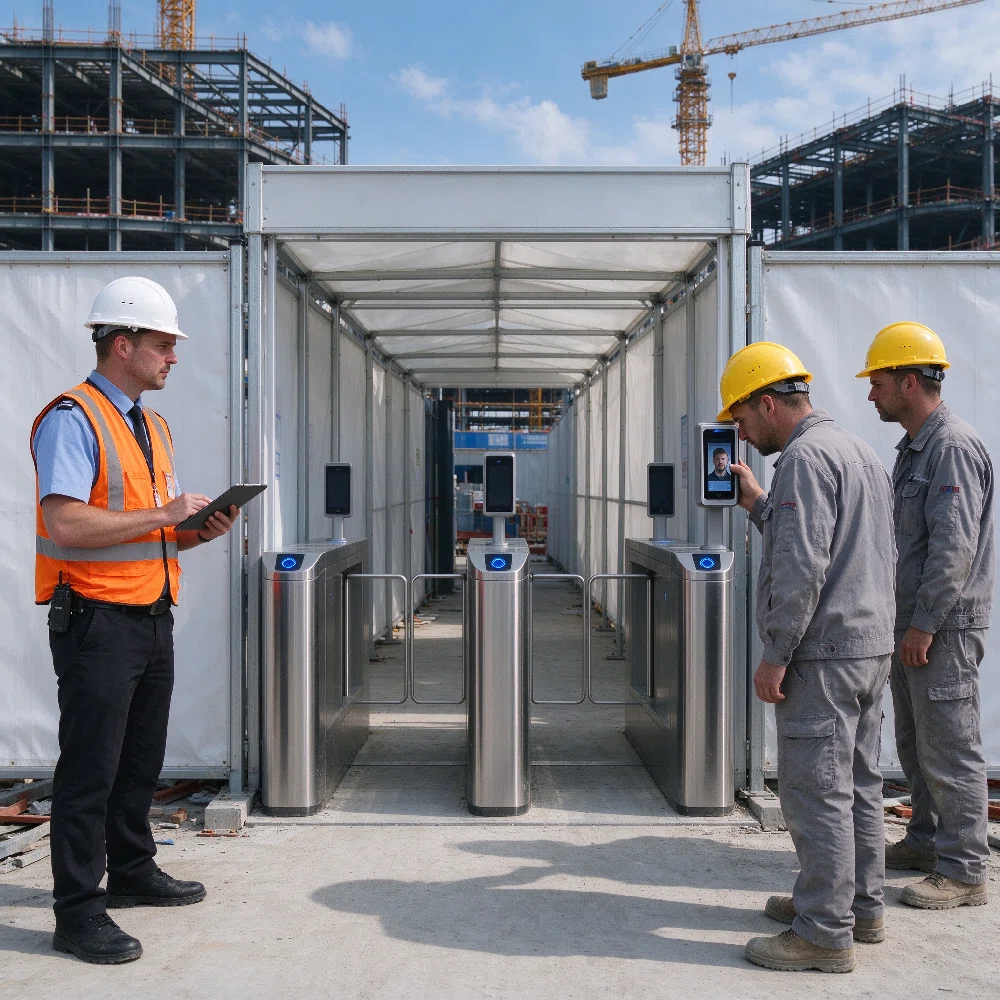
When evaluating biometric systems, it’s also important to consider real-world deployment scenarios such as construction environments
However, as we delve deeper into the question—”Which is better for factories: fingerprint or face recognition access control?”—the drawbacks of fingerprint technology within a factory setting become glaringly obvious:
Environmental Interference: Factory employees’ hands are frequently soiled with grease, dust, sweat, or chemicals. These contaminants can drastically reduce the success rate of fingerprint capture.
Fingerprint Wear: Employees engaged in heavy manual labor over extended periods often suffer from worn-down or peeling fingerprints, rendering them unrecognizable to the system.
Equipment Deterioration: Fingerprint sensors are contact-based devices; the constant friction and exposure to industrial grime cause the sensor surfaces to degrade rapidly, resulting in prohibitively high maintenance costs.
Hygiene Risks: In densely populated factory environments, where thousands of individuals touch the same sensor, there exists a significant risk of cross-contamination.
Modern Facial Recognition: The Ideal Companion for Industry 4.0
With leaps forward in deep learning and edge computing capabilities, facial recognition has emerged as a powerful tool for addressing pain points in industrial management.
Efficient, Contactless Access
Unlike fingerprint scanning, facial recognition is entirely contactless. This means employees do not need to break their stride—verification can be completed even while they are carrying goods in both hands. For factories with thousands of employees, this “seamless access” translates into a significant reduction in queuing times at turnstiles during peak morning and evening hours.
Adapting to PPE (Personal Protective Equipment)
On modern production lines, employees are required to wear safety helmets, face masks, or protective goggles. Specialized AI-powered facial recognition terminals (internal link) can accurately verify identities by analyzing eye and upper-face features—all without requiring the removal of protective gear. This establishes a secure closed-loop system that is entirely beyond the capabilities of fingerprint recognition.
Algorithmic Moats: WDR and Liveness Detection
When addressing the question—”Which is better for factories: fingerprint or face recognition access control?”—technological robustness is paramount. Drawing upon a wealth of “visual DNA” accumulated since 2004, Cheyuansu has integrated True Wide Dynamic Range (True WDR) technology into its access control terminals. Whether at a factory gate exposed to direct sunlight or within the dimly lit corridors of a warehouse, the system automatically compensates for lighting variations, thereby ensuring recognition accuracy.
According to the International Organization for Standardization (ISO) definitions regarding biometric performance, recognition accuracy directly determines the security of a system. Our 3D Liveness Detection algorithm, powered by dual-camera infrared technology, can instantly detect and thwart fraudulent attacks involving photographs, videos, or even silicone masks, ensuring that only genuine human beings gain access to critical workshop areas.
Technology Comparison: Fingerprint vs. Facial Recognition
| Evaluation Dimensions | Fingerprint Recognition | Facial Recognition |
| Sanitary Level | Low (Frequent Contact) | High (Non-Contact) |
| Recognition Speed | 1–2 seconds (requires contact) | < 0.3 seconds (contactless passage) |
| Environmental Adaptability | Poor (susceptible to oil stains and dust) | Strong (supports WDR; adaptable to extreme lighting conditions) |
| Durability | Sensors prone to wear | Long hardware lifespan (no physical contact) |
| Security Level | Medium (Easily forged) | High (3D Liveness Detection) |
| PPE Compatibility | Requires Glove Removal | Supports Hard Hat/Face Mask Detection |

In-Depth Analysis: Why Does Facial Recognition Deliver a Superior ROI in Factory Settings?
At first glance—when looking solely at the unit price of hardware—many decision-makers assume that fingerprint-based systems are the more cost-effective option. However, when addressing the question, “Which is better for factories: fingerprint or face recognition access control?” it is essential that we calculate the Total Cost of Ownership (TCO).
Differences in Maintenance Costs
Fingerprint sensors require periodic cleaning and, under conditions of high-frequency usage, may need to be replaced every 1 to 2 years. In contrast, as an optical sensing device, the core components of a facial recognition terminal do not come into physical contact with the human body; consequently, its hardware lifespan is typically 3 to 5 times longer than that of fingerprint-based devices.
Edge Computing and Management Efficiency
Cheyuansu’s facial recognition terminals support Edge Computing , performing all matching operations locally without consuming campus network bandwidth. This architecture ensures that the system remains stable and fully operational even in the event of a network outage, thereby guaranteeing uninterrupted factory production.
Advanced technologies like edge computing are also transforming biometric terminals:
Data Privacy and Compliance
Modern factories must be not only efficient but also compliant. In accordance with best practices published by the Biometrics Institute , local data storage and encryption are critical to safeguarding employee privacy. Our system employs anonymization algorithms to store feature vectors—rather than raw images—thereby eliminating the risk of data leakage at the fundamental technical level.
FAQ: Expert Answers on Selecting Industrial Access Control Systems
Factory lighting conditions are poor; will facial recognition work?
The answer is a resounding yes. For industrial environments, the key technical differentiator lies in WDR (Wide Dynamic Range) technology. Our access control terminals utilize hardware-level WDR technology exceeding 120dB; combined with infrared fill lights, they can achieve millisecond-level recognition even in pitch-black conditions or environments with strong backlighting.
Will recognition accuracy decrease if employees are wearing hard hats and face masks?
Our deep learning models have been trained on massive datasets from industrial scenarios, enabling them to extract over 100 distinct facial feature points. As long as the eye and forehead regions remain visible, the system maintains a recognition accuracy of over 99.9%, eliminating the need for employees to remove their protective gear.
Is the facial recognition system heavily dependent on network connectivity?
No. The recommended best practice involves utilizing edge-side recognition. Each terminal functions as an independent computing hub; even if the factory’s local area network (LAN) goes down, employees can still enter and exit normally via facial scanning, and data will automatically synchronize once network connectivity is restored.
Under what circumstances does fingerprint recognition still offer value?
For small indoor workshops characterized by extremely clean environments, a very small workforce, and a strictly limited budget, fingerprint recognition remains a viable, low-cost solution. However, in any modern factory setting involving large-scale operations, outdoor environments, or highly dynamic workflows, the advantages of facial recognition are overwhelming.
Future-Ready Choices for Smart Factories
Returning to the original question: Which is better for factories—fingerprint or face recognition access control?
If you manage a modern industrial park that prioritizes maximum efficiency, emphasizes production safety, and operates within a complex and dynamic environment, a face recognition access control system is—without a doubt—the optimal choice. It eliminates the drawbacks associated with contact-based identification, resolves the unique recognition challenges inherent to industrial settings, and provides ample room for future expansion to support digital management initiatives.
Leveraging our deep expertise in visual algorithms—cultivated since 2004—and the robust technical foundation established through our extensive collaboration with Mobileye, a global pioneer in autonomous driving, Cheyuansu is dedicated to bringing this “automotive-grade” level of visual reliability to the entrance of every factory.
If you are currently seeking a highly reliable access control solution for your factory, we invite you to review our AI Smart Terminal Product Brochure or contact our technical experts directly to receive an in-depth analysis report tailored specifically to your on-site environment.