
Introduction
When companies consider implementing facial recognition technology, one of the first questions they ask is:
How much does facial recognition software cost?
The answer is not as simple as purchasing a camera or installing a traditional access control system.
Modern facial recognition solutions are complex platforms that combine:
- AI algorithms
- Computer vision technology
- Identity verification systems
- Cloud management platforms
- Database integration
- Hardware terminals
- Security software
Therefore, facial recognition software costs can vary significantly depending on the project requirements, deployment environment, number of users, and required features.
A small office attendance application may require only a basic facial recognition solution, while a large industrial park, university campus, or enterprise security project may require advanced AI infrastructure with thousands of users and multiple access points.
For businesses evaluating biometric technology investments, understanding the different cost components is essential before selecting a supplier.
Many organizations start by comparing software prices, but successful projects usually evaluate the complete ecosystem, including hardware reliability, integration capability, and long-term maintenance.
Modern companies often combine facial recognition software with professional facial recognition access control systems to create complete identity management solutions for factories, offices, campuses, and industrial environments.
According to the National Institute of Standards and Technology (NIST) Face Recognition Vendor Test, recognition accuracy, algorithm performance, and environmental conditions significantly influence the effectiveness of facial recognition technologies.
This means businesses should not evaluate facial recognition software costs based only on subscription fees.
They should consider the complete value of the solution.
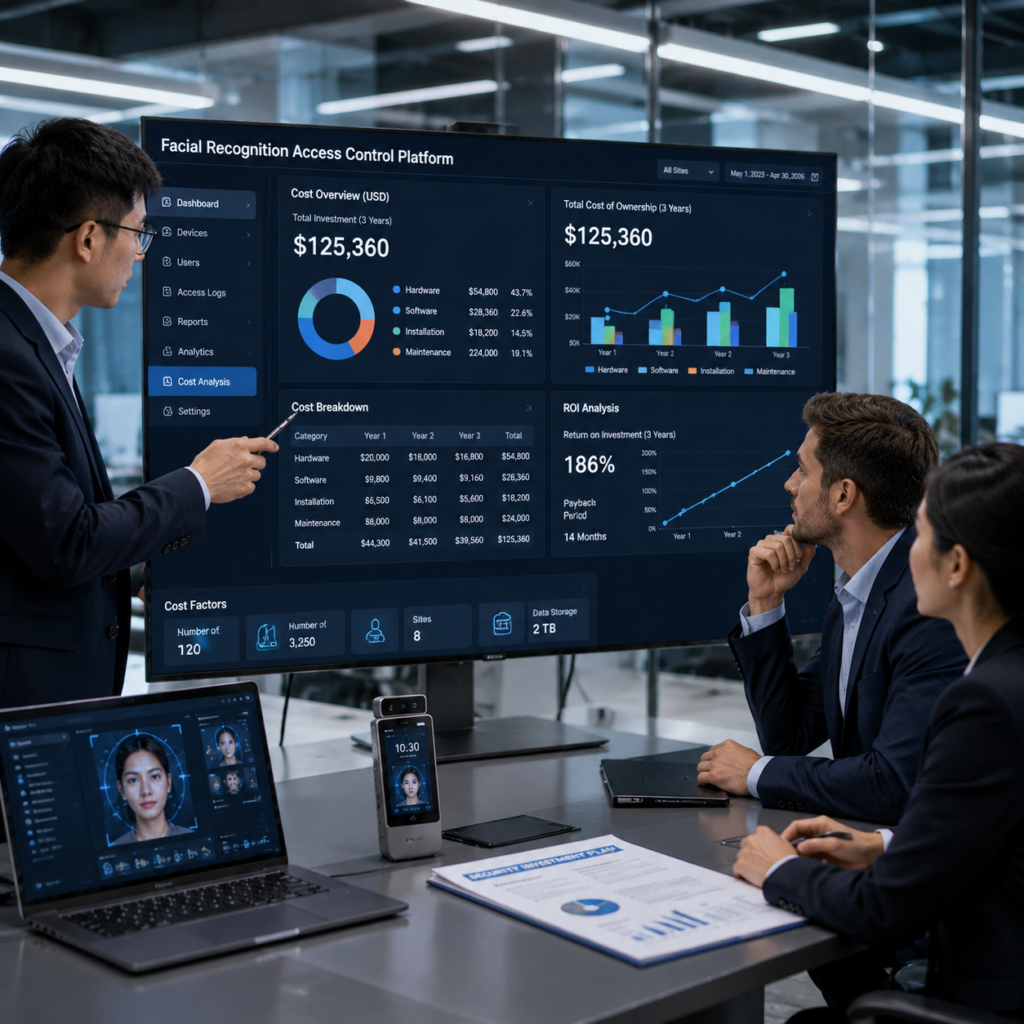
What Factors Determine Facial Recognition Software Costs?
The price of facial recognition software depends on several technical and business factors.
Unlike traditional software products, biometric systems require advanced AI processing capabilities and continuous development.
The main factors include:
1. AI Algorithm Complexity
The AI algorithm is one of the biggest contributors to facial recognition software costs.
Basic systems may only provide simple identity matching.
However, enterprise-level solutions require advanced capabilities such as:
- High-speed recognition
- Deep learning models
- Anti-spoofing detection
- Mask recognition
- Low-light recognition
- Multi-angle face matching
More advanced algorithms require greater research investment and computing resources.
For example, systems used in airports, factories, and universities require higher accuracy than simple office applications.
Companies looking for advanced biometric solutions should also evaluate technologies such as dynamic facial recognition, which improves recognition performance when users are moving or when environments change.
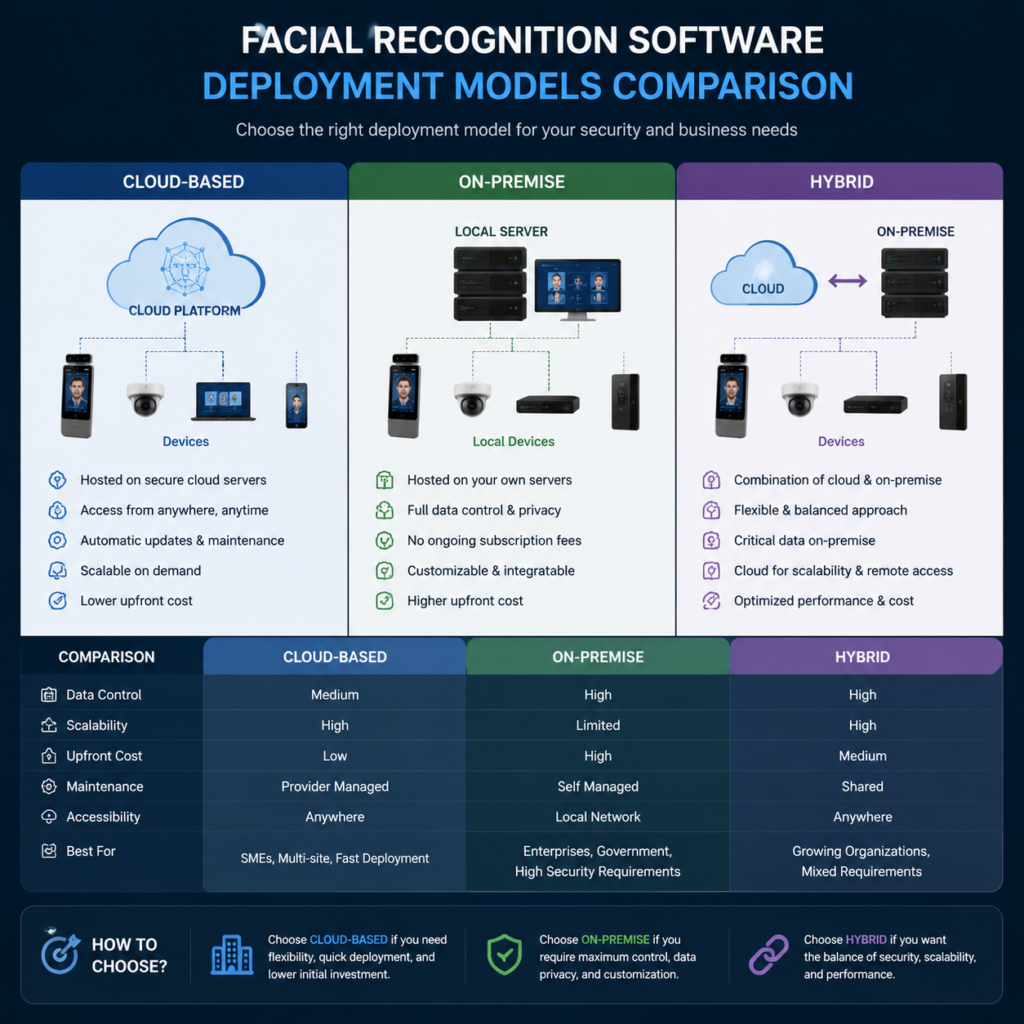
Deployment Model: Cloud, On-Premise, or Hybrid
One of the biggest factors affecting facial recognition software costs is the deployment model.
Most solutions fall into three categories:
Cloud-Based Facial Recognition Software
Cloud solutions usually operate through monthly or annual subscriptions.
Advantages include:
- Lower initial investment
- Easy scalability
- Automatic updates
- Remote management
Cloud systems are popular among:
- Small businesses
- Retail companies
- Multi-location enterprises
However, long-term subscription costs should be considered carefully.
On-Premise Facial Recognition Software
On-premise solutions are installed on company servers.
They are commonly used by:
- Government organizations
- Large factories
- Universities
- High-security facilities
Advantages include:
- More control over data
- Better customization
- Reduced dependency on external platforms
However, they usually require higher initial investment.
Hybrid Deployment
Many enterprises choose hybrid solutions.
For example:
- Local facial recognition terminals
- Cloud management platform
- Centralized reporting system
This model provides flexibility between security and scalability.
Average Facial Recognition Software Cost by Application Scenario
Different industries have different requirements, which directly affects pricing.
Small Business Facial Recognition Systems
Small offices usually need:
- Employee attendance
- Basic access control
- Limited users
Typical requirements:
- 50–500 users
- One or several access points
- Basic reporting
Costs are usually lower because the system does not require complex integration.
Enterprise Facial Recognition Solutions
Large companies often require:
- Multiple buildings
- Thousands of employees
- HR integration
- Visitor management
- Centralized monitoring
Enterprise solutions usually include:
- Advanced AI algorithms
- Multiple terminals
- Cloud dashboard
- API integration
The total investment can be significantly higher.
Many companies combine facial recognition with an office attendance system to improve workforce management.
Industrial and Factory Applications
Factories usually require more than simple identification.
They often need:
- Employee access management
- Shift tracking
- Restricted area control
- Safety compliance
In these environments, facial recognition software is integrated with industrial access control platforms.
Companies should also evaluate whether suppliers have experience as an access control solution provider, because successful industrial deployments require both hardware and software capabilities.
Different Facial Recognition Software Pricing Models Explained
When evaluating facial recognition software costs, buyers should understand that software pricing is usually based on different business models.
Choosing the wrong pricing structure can create unnecessary expenses over the lifecycle of the project.
The most common pricing models include:
1. Subscription-Based Facial Recognition Software
Subscription pricing is becoming increasingly popular.
Under this model, customers usually pay:
- Monthly fees
- Annual licenses
- Per-user charges
- Per-device charges
Advantages include:
- Lower upfront investment
- Regular software updates
- Cloud maintenance included
- Easier scalability
This model works well for:
- Small businesses
- Retail chains
- Startups
- Distributed offices
However, companies should calculate the total cost over several years.
A low monthly subscription may become more expensive than a one-time license after long-term usage.
2. Perpetual License Model
Some enterprise customers prefer a one-time software license.
The company purchases the software permanently and pays separately for:
- Maintenance
- Updates
- Technical support
This model is common in:
- Government projects
- Universities
- Industrial facilities
- Large enterprises
The initial investment is usually higher, but long-term operating costs may be lower.
3. Customized OEM Facial Recognition Software
For brands, distributors, and system integrators, customized solutions are often the preferred option.
An OEM face recognition system allows companies to create products under their own brand.
Customization may include:
- User interface design
- Logo branding
- Cloud platform customization
- API integration
- Firmware modification
- Industry-specific functions
OEM solutions are especially attractive for companies that want to build their own security product ecosystem.
Many global security brands cooperate with Chinese manufacturers because they can provide both hardware production and software customization.
For companies exploring OEM cooperation, our previous guide on choosing a reliable face recognition manufacturer China explains important supplier evaluation factors.
Hidden Costs That Affect Facial Recognition Software Investment
Many buyers focus only on the initial software price.
However, successful biometric projects require considering additional costs.
Understanding these hidden factors helps companies create more accurate budgets.
Hardware Compatibility Costs
Facial recognition software does not work independently.
Most deployments require compatible hardware including:
- Facial recognition terminals
- Cameras
- Servers
- Access controllers
- Network equipment
A low-cost software platform may become expensive if it requires proprietary hardware.
Therefore, buyers should evaluate whether the software supports flexible hardware integration.
Integration and Development Costs
Enterprise projects often require integration with existing systems.
Examples include:
- HR software
- ERP systems
- Visitor management platforms
- Building management systems
- University systems
API development and customization can significantly affect the final budget.
Professional suppliers should provide:
- SDK documentation
- Technical support
- Integration examples
Maintenance and Upgrade Costs
AI technology changes rapidly.
A facial recognition system deployed today may require:
- Algorithm improvements
- Security updates
- Firmware upgrades
- Database optimization
Choosing a supplier with strong technical support is essential.
Data Security and Compliance Costs
Biometric data is highly sensitive.
Companies must consider:
- Data encryption
- Access permissions
- Storage policies
- Local privacy regulations
For international projects, compliance requirements may affect system design.
Organizations should evaluate whether suppliers follow recognized security practices.
How OEM Manufacturers Help Reduce Facial Recognition Software Costs
Working directly with an experienced manufacturer can significantly reduce project expenses.
Instead of purchasing separate components from multiple suppliers, businesses can obtain integrated solutions.
A professional biometric access control supplier can provide:
- Hardware
- Software
- Firmware
- Cloud platform
- Technical support
under one partnership.
This reduces:
- Development time
- Communication costs
- Integration problems
- Supply chain complexity
Chinese manufacturers have become popular partners because they combine:
- Electronics manufacturing capability
- AI engineering experience
- Software development teams
- Large-scale production capacity
For example, many companies looking for customized biometric terminals choose OEM suppliers that already have experience developing:
- Facial recognition machines
- Attendance terminals
- Visitor kiosks
- Industrial access control devices
How to Choose the Right Facial Recognition Software Supplier
Price should never be the only selection criteria.
A reliable supplier should demonstrate:
Technical Experience
Check whether the supplier has experience with:
- AI facial recognition algorithms
- Access control integration
- Cloud platforms
- Industry applications
A company with successful deployments is usually more reliable than a company selling only standard products.
Industry Knowledge
Different industries have different requirements.
For example:
Factories need:
- Worker management
- Safety integration
- Restricted access
Universities need:
- Student attendance
- Dormitory management
- Campus security
Construction projects need:
- Worker authentication
- Safety compliance
Therefore, selecting a supplier with industry experience is important.
Manufacturing Capability
For large projects, evaluate:
- Production capacity
- Quality control
- Testing procedures
- Supply chain stability
A supplier should be able to support both small pilot projects and large-scale deployment.
Future Trends Affecting Facial Recognition Software Costs
The future development of facial recognition technology will continue changing pricing models.
Several trends are becoming increasingly important.
Edge AI Will Reduce Cloud Dependency
More facial recognition terminals are adopting edge computing.
This allows devices to process recognition locally.
Benefits include:
- Faster response
- Lower cloud costs
- Improved privacy
- Better reliability
AI Platforms Will Replace Standalone Software
Future systems will not only recognize faces.
They will integrate:
- Access control
- Attendance
- Visitor management
- Security monitoring
- Business analytics
Facial recognition will become part of a complete intelligent management ecosystem.
This trend is already visible in smart campuses, factories, and industrial parks.
Companies interested in broader AI security applications can also explore our article about AI smart campus management systems.
Customized OEM Solutions Will Continue Growing
More companies want their own branded security products.
Therefore, OEM and ODM cooperation will become increasingly important.
Manufacturers that can provide complete solutions will have stronger advantages.
Conclusion: Understanding Facial Recognition Software Costs Before Investing
Facial recognition software costs depend on much more than software licensing fees.
The total investment is influenced by:
- AI algorithm capabilities
- Deployment model
- Hardware requirements
- Integration complexity
- Maintenance needs
- Security requirements
Businesses should avoid choosing solutions based only on the lowest price.
A successful facial recognition project requires a reliable technology partner capable of delivering:
- Stable software
- High-performance hardware
- Flexible customization
- Long-term support
Whether you are building an enterprise security system, university campus platform, factory access solution, or commercial smart building project, selecting the right supplier is the key factor that determines long-term success.
By understanding the real cost structure behind facial recognition technology, companies can make better investment decisions and build scalable biometric security systems for the future.
How much does facial recognition software cost?
Facial recognition software costs vary depending on users, features, deployment model, and integration requirements. Basic systems may cost hundreds of dollars, while enterprise solutions can require thousands or more.
What factors affect facial recognition software costs the most?
The biggest factors include AI algorithm complexity, number of users, hardware requirements, customization needs, API integration, and maintenance services.
Is cloud-based facial recognition software cheaper than on-premise solutions?
Cloud solutions usually require lower initial investment, while on-premise systems may provide better control and lower long-term subscription costs for large organizations.
Can facial recognition software work with existing access control systems?
Yes. Professional facial recognition platforms can integrate with many existing access control systems through APIs, SDKs, and third-party integrations.
Why do companies choose OEM facial recognition systems?
OEM solutions allow companies to customize branding, software functions, firmware, and hardware while reducing development costs and accelerating product launch.
How can businesses reduce facial recognition system costs?
Companies can reduce costs by selecting experienced OEM manufacturers, choosing suitable deployment models, avoiding unnecessary customization, and planning long-term maintenance requirements.
What should I look for in a biometric access control supplier?
Important factors include AI technology capability, manufacturing experience, software integration support, certifications, quality control, and after-sales service.

