
Executive Summary
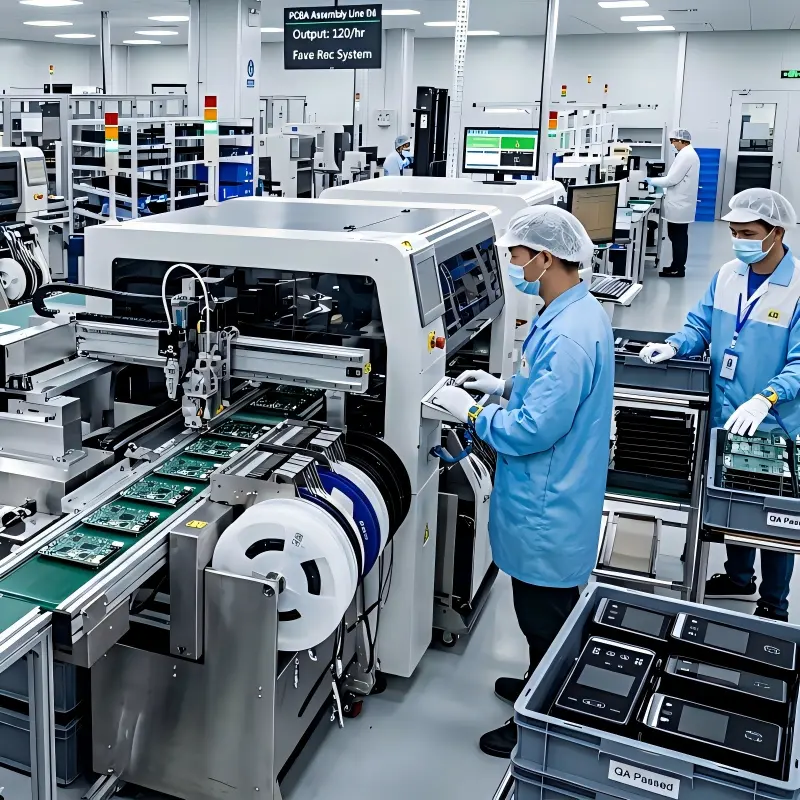
The global market for biometric security demands more than standard software features; it requires rugged, scalable, and enterprise-grade hardware. For B2B procurement professionals, sourcing a facial recognition machine—whether for access control, workforce management, or smart infrastructure—is a high-stakes decision. Product reliability and ROI depend entirely on the manufacturer’s hardware integration capabilities, component sourcing, and quality control.
This comprehensive manufacturing guide analyzes the architectural anatomy of enterprise biometric terminals, differentiates between OEM/ODM sourcing models, and outlines critical supplier compliance frameworks to future-proof your supply chain.
1. Hardware Architecture: The Core Components of Enterprise Terminals
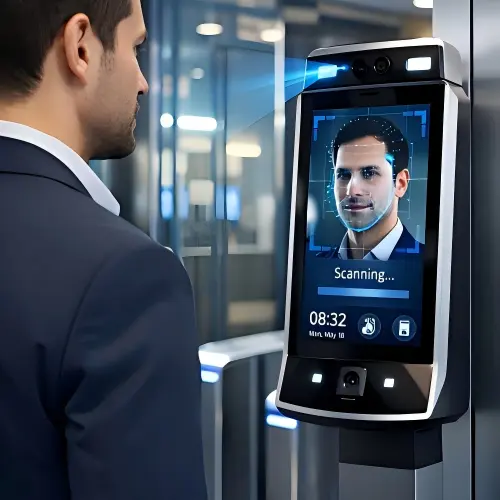
To evaluate a facial recognition hardware supplier, you must look past the outer casing. Premium biometric terminals rely on the seamless synergy of four core hardware layers:
A. Advanced Imaging Systems (Dual-Camera & 3D Sensors)
Standard RGB cameras are highly vulnerable to environmental lighting shifts and simple photo-spoofing. Enterprise-grade machines must utilize a Dual-Light System:
- Visible Light (RGB) Camera: Captures high-resolution color data for texture and detail analysis under optimal lighting.
- Near-Infrared (NIR) Camera: Operates independently of ambient light, cross-checking facial geometry in complete darkness or harsh backlighting.
- 3D Depth Sensors (ToF / Structured Light): Essential for high-security areas. Time-of-Flight (ToF) sensors map facial contours in real-time to eliminate 2D presentation attacks (photos, videos, or silicon masks).
B. Edge Computing & Neural Processing Units (NPUs)
Modern access control heavily relies on edge computing to guarantee sub-0.5-second verification speeds and data privacy.
- On-Device Processing: Instead of routing video streams to a vulnerable cloud server, look for suppliers utilizing System-on-Chips (SoCs) with dedicated NPUs (Neural Processing Units) boasting at least 1.0 to 2.0 TOPS (Trillion Operations Per Second) of AI computing power.
- This architecture allows the terminal to run complex convolutional neural networks (CNNs) locally, ensuring operation even during network outages.
C. Industrial-Grade Connectivity & Enclosures
For industrial time attendance or outdoor perimeter security, environmental resilience is mandatory. Ensure your manufacturer offers:
- Ingress Protection: IP65 or IP66-rated weatherproofing.
- Vandal Resistance: IK08+ impact-rated glass and aluminum alloy housings.
- Interface Versatility: Wiegand, OSDP (Open Supervised Device Protocol), Relays, PoE+ (Power over Ethernet), and 4G/5G failover modules for legacy and modern system integration.
2. OEM vs. ODM Sourcing: Aligning Strategy with Market Timeline
Choosing between an Original Equipment Manufacturer (OEM) and an Original Design Manufacturer (ODM) dictates your upfront R&D investment and time-to-market.
| Sourcing Dimension | OEM (Original Equipment Manufacturer) | ODM (Original Design Manufacturer) |
| Design Ownership | Buyer provides proprietary blueprints and custom hardware specifications. | Supplier owns the pre-developed product platform and circuitry. |
| Customization Depth | Deep hardware alteration (custom PCB layouts, unique sensor integration). | White-labeling, custom branding, and firmware modifications. |
| Upfront Cost (NRE) | High Non-Recurring Engineering (NRE) fees for tooling and prototyping. | Low to zero tooling fees; lower initial capital requirement. |
| Time-to-Market | 6–12 months (due to rigorous testing and certification cycles). | 1–3 months (ready-to-ship hardware platforms). |
Strategic Recommendation: Opt for an OEM partnership if you are developing a patented, highly specialized security solution for a regulated niche. Choose an ODM supplier if your primary goal is rapid market entry with a cost-optimized, field-tested access control terminal.
3. Supplier Evaluation Checklist: Vetting B2B Biometric Manufacturers
To secure a reliable hardware supply chain, procurement teams must look for strict compliance and verifiable manufacturing standards.
1. Algorithmic and Cryptographic Certifications
Hardware is only as secure as the data it processes. Ensure the manufacturer’s underlying facial recognition algorithms regularly participate in the NIST FRVT (Face Recognition Vendor Test), achieving top-tier accuracy rankings across diverse demographics. Furthermore, check for:
- Compliance Frameworks: GDPR (Europe), CCPA (California), and BIPA (Illinois) compliance regarding on-device data encryption (AES-256) and biometric hashing templates.
- Hardware Compliance: CE, FCC, and NDAA Compliance (National Defense Authorization Act), which is critical for selling into US government, defense, or critical infrastructure sectors.
2. Supply Chain Integrity & Component Sourcing
Ask potential manufacturers for their BOM (Bill of Materials) transparency. Tier-1 suppliers source image sensors from reputable brands (e.g., Sony, OmniVision) and processors from established silicon vendors (e.g., Rockchip, NXP). Avoid suppliers utilizing unbranded or gray-market components, as these lead to high failure rates and component obsolescence within 12–18 months.
3. Rigorous Quality Control (QC) Processes
A world-class hardware factory must demonstrate proof of:
- ISO 9001 & ISO 27001 certifications.
- Environmental Chamber Testing: Thermal cycling tests (e.g., operating stability from -20 to 60.
- MTBF (Mean Time Between Failures): Verifiable MTBF ratings exceeding 50,000 hours of continuous operation.
4. Key Trends Shaping Biometric Sourcing
The Rise of Liveness Detection (Anti-Spoofing)
Hardware-assisted liveness detection (both active and passive) has become a mandatory procurement specification. By combining software algorithms with infrared and depth sensors, modern machines can accurately differentiate between a live human being and a high-resolution spoofing attack within milliseconds. Learn more about the integration mechanics of live detection and anti-spoofing technologies to ensure your hardware meets modern security thresholds.
Decentralized Biometrics via Edge Intelligence
Modern deployments are moving away from massive centralized biometric databases due to hacking risks. Hardware that leverages edge computing in biometric terminals allows for distributed data architecture, significantly lowering cloud bandwidth costs and increasing system-wide privacy compliance.
Technical FAQ for Procurement Managers
Can these facial recognition machines operate entirely offline?
Yes. Enterprise-grade terminals feature onboard flash storage (eMMC) capable of storing local databases of 10,000 to 100,000 local biometric face templates. The device performs mathematical matching locally on the NPU and pushes logs to the central system once connectivity is re-established.
What is the average lifespan of an outdoor biometric terminal?
Industrial-grade devices manufactured with aluminum/zinc alloy housings, impact-resistant glass, and certified thermal management components possess an expected lifespan of 5 to 7 years under continuous operation.
How do manufacturers handle firmware updates and vulnerability patching?
Reputable access control solution providers offer robust OTA (Over-The-Air) firmware deployment capabilities, ensuring security patches and algorithm updates can be pushed seamlessly across thousands of deployed edge devices without requiring physical maintenance.
Conclusion
Investing in a facial recognition machine fleet is a multi-year strategic commitment. For B2B buyers, evaluating the factory’s quality control, NPU edge capacity, and dual-light imaging architecture is far more critical than comparing software UI mockups. By prioritizing suppliers with proven R&D capabilities, transparent component sourcing, and international compliance certifications, procurement teams can safeguard their investments and deliver highly secure, future-ready infrastructure.