Introduction
Modern pedestrian access control is no longer simply about opening a gate when a user presents a card or completes biometric verification. In many commercial, industrial and institutional environments, the system must also determine whether the person passing through the entrance is actually authorized to enter.
One of the most important security challenges is tailgating. Tailgating occurs when an unauthorized person follows an authorized user through a controlled entrance without completing an independent authentication process.
For facilities with a high number of employees, visitors or contractors, this can create a significant security gap. A properly designed turnstile anti-tailgating technology system uses sensors, control logic and gate movement detection to reduce this risk while maintaining smooth pedestrian flow.
Modern turnstile systems can combine physical barriers with authentication devices, sensors and management software. New Auto Element’s product range includes speed gates, flap barrier gates, swing barriers and facial recognition terminals designed for different entrance environments.
What Is Tailgating in Access Control?
Tailgating happens when two or more people pass through a controlled entrance after only one person has been successfully authorized.
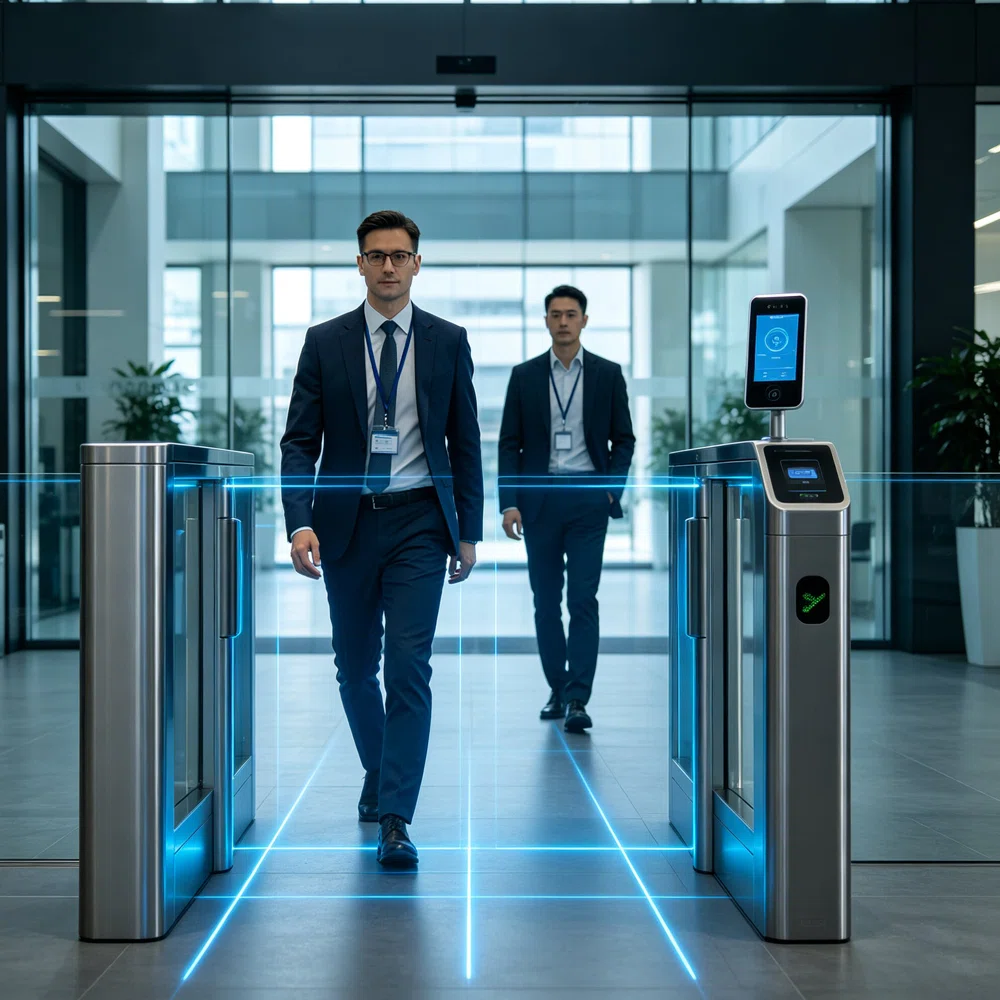
For example, an employee may present an access card and the gate opens. Another person then attempts to walk through the same opening before the gate closes.
In a traditional entrance without sufficient detection technology, the system may record only the first person’s authentication event.
This creates a difference between:
Authentication
and
Actual passage.
A modern pedestrian entrance should therefore consider not only whether a credential is valid, but also whether the physical movement through the gate corresponds with the authorization event.
This is where anti-tailgating technology becomes important.
How Does Turnstile Anti-Tailgating Technology Work?
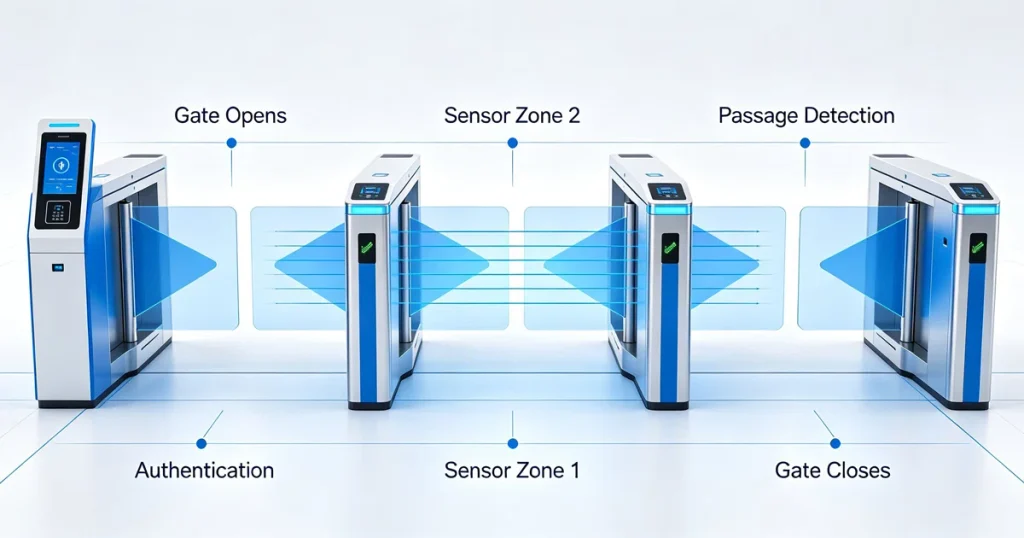
A modern anti-tailgating system generally combines several technologies:
- Authentication device
- Infrared or optical sensors
- Gate position detection
- Control board
- Motor system
- Access management software
The basic process can be represented as:
User Authentication
        ↓
Access Authorization
        ↓
Gate Opens
        ↓
Pedestrian Detection
        ↓
Passage Monitoring
        ↓
Gate Closes
        ↓
Access Event Recorded
The system does not simply ask whether access was granted.
It also monitors what happens during the passage process.
This allows the entrance system to identify abnormal movement patterns and trigger appropriate responses according to the project’s configuration.
Why Are Sensors Important?
Sensors are one of the most important components of pedestrian entrance security.
When a person enters the lane, sensors can help determine:
- Whether someone is inside the passage area
- Whether the person has passed the gate
- Whether another person is following
- Whether an object is blocking the passage
- Whether the gate should remain open or close
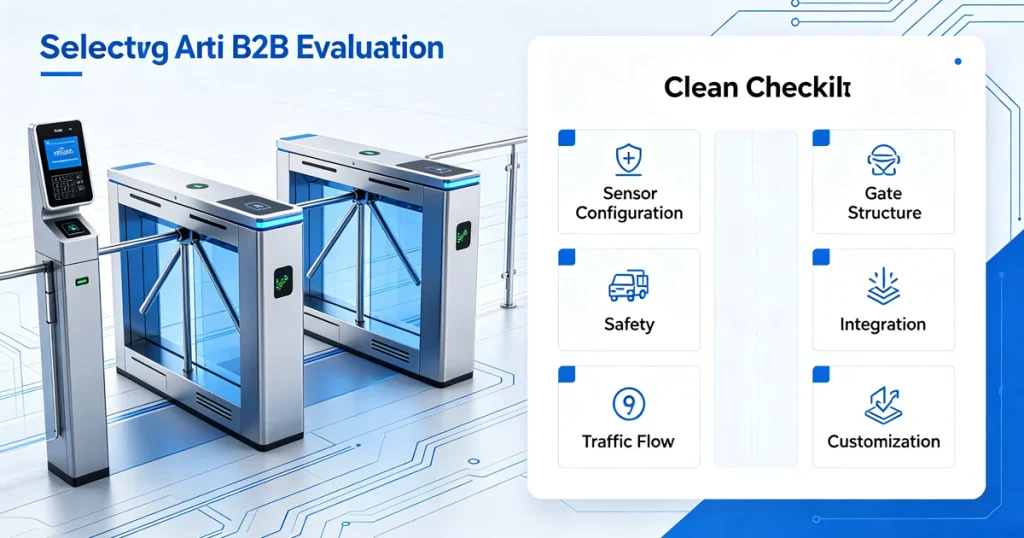
For this reason, buyers should evaluate sensor configuration when selecting a turnstile rather than comparing only the external appearance or material.
Different gate structures may require different sensor layouts.
A high-quality entrance system should balance detection accuracy with normal pedestrian movement to reduce both unauthorized passage and unnecessary alarms.
Optical and Infrared Detection
Many pedestrian gates use infrared or optical detection to monitor movement through the lane.
The detection zones can be positioned at different points along the passage area.
For example:
Entrance
   ↓
[Detection Zone 1]
   ↓
[Detection Zone 2]
   ↓
[Detection Zone 3]
   ↓
Exit
By monitoring changes across these zones, the controller can determine whether the pedestrian movement is consistent with the expected access sequence.
The exact sensor configuration depends on the gate design, lane width and project requirements.
This is especially important for locations with high pedestrian traffic, where false alarms can negatively affect the user experience.
Anti-Tailgating and Pedestrian Flow
Security should not come at the expense of usability.
An entrance system that generates excessive false alarms may cause:
- Congestion
- User frustration
- Slower entry
- Increased security workload
Therefore, turnstile tailgating prevention should be designed together with pedestrian flow management.For example, an office building may have hundreds or thousands of employees entering within a short period in the morning.
The system must identify unauthorized passage while still allowing authorized users to move through the entrance efficiently.This is why gate speed, sensor response, motor control and authentication time should be considered as one complete system.
For commercial projects that prioritize fast pedestrian movement, buyers can also compare Smart Speed Gate Systems according to entrance width, traffic volume, security requirements and pedestrian flow..
What Happens When Tailgating Is Detected?
The response depends on the access control system configuration.Possible responses include:
- Gate remains locked
- Gate closes automatically
- Audible warning
- Visual warning
- Security notification
- Event recorded in management software
- Security personnel alerted
The appropriate response depends on the facility.
For example, an office may use an audible warning for minor violations, while a restricted industrial facility may require an immediate security alert.
The important point is that the turnstile should be able to communicate detection events to the wider access management system.
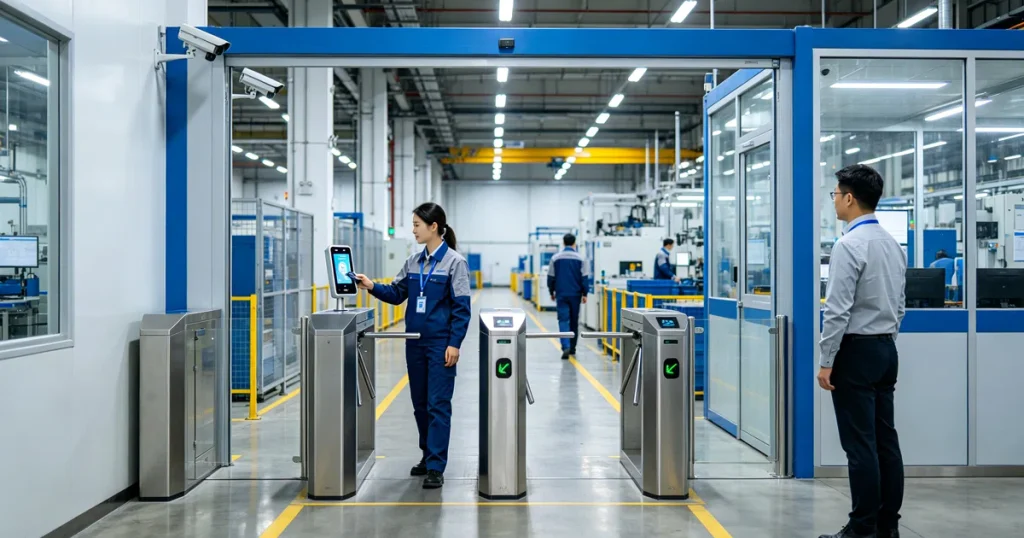
Anti-Tailgating for Manufacturing Facilities
Manufacturing facilities often have multiple categories of users:
- Employees
- Contractors
- Visitors
- Maintenance personnel
- Management staff
Different areas may also require different access permissions.
For example, an employee may be authorized to enter a production building but not a restricted equipment room.
An anti-tailgating entrance helps ensure that physical access corresponds more closely with the user’s authorization.
In factories with multiple entrances, the system can also be connected to centralized management software so that security teams can review entrance events and identify abnormal activity.
This approach is particularly useful when combined with employee authentication and visitor management.
Anti-Tailgating for Offices and Commercial Buildings
Office buildings face a different challenge.The main requirement is usually to combine security with a smooth user experience.
Employees may use:
- RFID cards
- Mobile credentials
- QR codes
- Facial recognition
The gate must authenticate the user quickly and then monitor the passage.
A properly configured anti-tailgating system can help reduce unauthorized entry without turning every entrance into a slow security checkpoint.
For organizations evaluating different gate designs, New Auto Element provides multiple pedestrian entrance products, including flap barriers, swing barriers, tripod turnstiles and speed gates.
Combining Anti-Tailgating With Biometric Authentication
Anti-tailgating technology can also work together with biometric authentication.
For example:
Facial Recognition
        ↓
Identity Verification
        ↓
Access Authorization
        ↓
Turnstile Opens
        ↓
Passage Detection
        ↓
Access Event
The authentication process determines who is authorized.
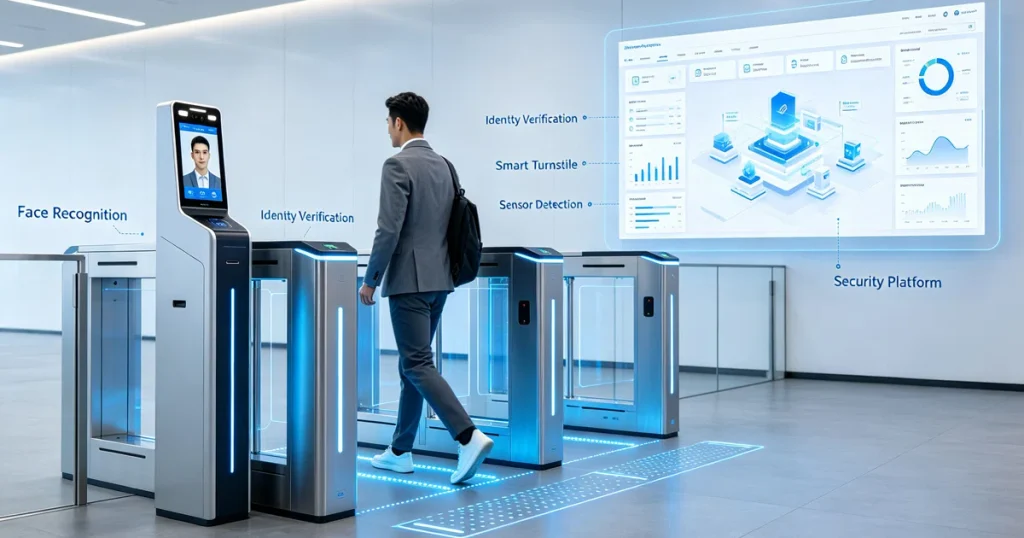
The sensor system helps determine what happens physically after authorization.
These are complementary functions.
For projects using facial recognition, buyers should evaluate both the biometric terminal and the physical gate rather than treating them as completely independent products.
New Auto Element’s product range includes AI facial recognition turnstiles and facial recognition terminals such as NAT-V5 Pro, NAT-V8SE and NAT-VX.
How Should Buyers Evaluate Anti-Tailgating Performance?
When comparing suppliers, buyers should ask several practical questions.
1. What detection technology is used?
Ask whether the system uses:
- Infrared sensors
- Optical sensors
- Position detection
- Multiple detection zones
2. How is tailgating handled?
The supplier should explain:
- Detection logic
- Gate response
- Alarm options
- Event recording
3. Can the system be customized?
Different projects have different requirements.
A factory may require stricter detection than an office lobby.
4. Can it connect to existing systems?
The gate may need to communicate with:
- Access control software
- Visitor management
- Attendance systems
- Security platforms
5. What safety functions are included?
Security and safety should be designed together.
A gate should not create unnecessary risks for legitimate users.
Anti-Tailgating and Access Control Security
Anti-tailgating is only one layer of a larger security architecture.
A complete system may include:
User Authentication
        +
Authorization
        +
Physical Gate
        +
Passage Detection
        +
Event Logging
        +
Security Management
For connected systems, software security should also be considered.
When access control platforms exchange information through APIs, system designers should evaluate API security best practices and appropriate authorization controls. OWASP’s API Security Project specifically addresses API-specific risks and mitigation strategies.
This is particularly relevant for projects that connect turnstiles with third-party software platforms.
Choosing the Right Turnstile for Tailgating Prevention
There is no single turnstile design that is ideal for every project.
Buyers should consider:
Traffic Volume
High-traffic facilities require fast and reliable pedestrian processing.
Security Level
Restricted facilities may require stronger physical barriers and more detailed passage monitoring.For restricted facilities, full height turnstiles can provide a stronger physical barrier where perimeter security is a priority.
Entrance Environment
Indoor and outdoor installations can have different environmental requirements.
Authentication Method
The gate should be compatible with the selected authentication technology.
Integration Requirements
System integrators should confirm communication interfaces and software compatibility before placing an order.
Customization
For distributors and project contractors, OEM customization may include:
- Appearance
- Dimensions
- Branding
- Firmware
- Interface
- Authentication configuration
New Auto Element describes its manufacturing model as supporting OEM/ODM customization and integration for global access control projects.
Why New Auto Element?
New Auto Element focuses on smart pedestrian entrance and biometric access control hardware for global projects.
Its product range includes:
- Speed gate turnstiles
- Flap barrier gates
- Swing barriers
- Tripod turnstiles
- Facial recognition terminals
The company also provides OEM/ODM support for customers requiring customized appearance, dimensions, branding and system integration.
For distributors, contractors and system integrators, the ability to combine physical gate hardware with authentication and management technologies can simplify project development and product sourcing.
Conclusion
Tailgating prevention is an important consideration when designing a modern pedestrian entrance security system.
A reliable solution does not depend on a single technology.
Instead, it combines:
- Authentication
- Authorization
- Sensors
- Gate control
- Passage monitoring
- Event management
The goal is to ensure that the person authorized to enter is also the person who actually passes through the controlled entrance.
For commercial buildings, factories, campuses and other controlled facilities, evaluating anti-tailgating capabilities during the product selection stage can help create a more secure and efficient entrance environment.
For OEM projects, the most suitable solution should be selected according to traffic volume, security requirements, authentication technology, environmental conditions and system integration needs.
FAQ
What is turnstile anti-tailgating technology?
Turnstile anti-tailgating technology uses sensors, gate control logic and access authorization information to help detect or prevent unauthorized people from following an authorized user through a controlled entrance.
How does a turnstile detect tailgating?
The system can use multiple sensors to monitor movement through the pedestrian lane and compare the detected movement with the expected authorized passage.
Why is anti-tailgating important for factories?
Factories may have employees, contractors and visitors with different access permissions. Anti-tailgating technology helps reduce unauthorized entry into controlled production and restricted areas.
Can facial recognition work with anti-tailgating turnstiles?
Yes. Facial recognition can authenticate the user, while the turnstile’s sensors monitor the physical passage.
Does every turnstile provide the same level of tailgating prevention?
No. Sensor configuration, gate structure, control logic and software integration can vary between models and suppliers.
Can anti-tailgating systems integrate with existing access control software?
Yes. Depending on the hardware and software architecture, turnstiles can communicate with access control and management platforms through supported interfaces and integration methods.
What should buyers ask a turnstile manufacturer?
Buyers should ask about sensor configuration, detection logic, safety functions, communication interfaces, software compatibility, customization and project support.