What are the benefits of edge computing in biometric terminals? An Industrial Perspective
In the rapidly evolving landscape of smart security, the shift from traditional cloud-dependent architectures to localized processing has been transformative. When facility managers and security directors ask, “What are the benefits of edge computing in biometric terminals?”, they are often looking for ways to streamline operations and enhance system reliability. At Shenzhen New Auto Element, with our roots in visual algorithm development dating back to 2004, we have witnessed how this transition to decentralized intelligence changes the way factories and campuses manage access control.
Edge computing in biometric terminals essentially moves the processing power from a remote server to the physical device itself. This shift is not merely a technical upgrade; it is a fundamental change that dictates the speed, security, and future-proofing of your entire security ecosystem.
Speed and Latency: The primary benefits of edge computing in biometric terminals
One of the most immediate benefits of edge computing in biometric terminals is the drastic reduction in latency. In a cloud-based system, every time a face is scanned, the biometric template must be uploaded, processed on a server, and then the authorization signal sent back to the gate. This process, while seemingly fast, introduces network jitter and potential bottlenecks.
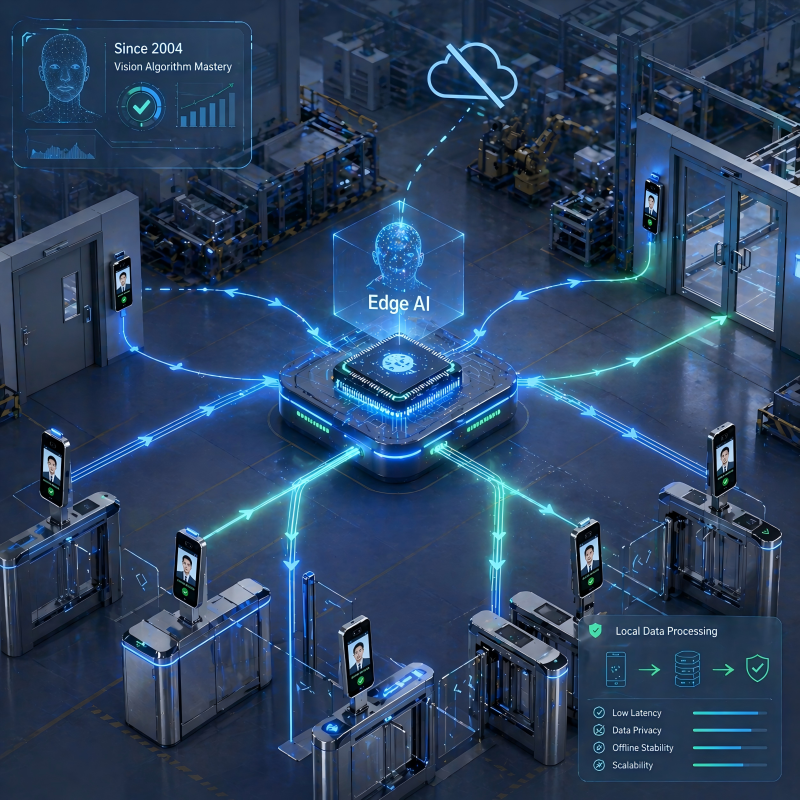
By integrating high-performance NPU (Neural Processing Unit) chips directly into the device, we achieve local recognition. When you analyze what are the benefits of edge computing in biometric terminals, the near-zero latency stands out as a critical operational advantage. In a busy manufacturing plant with thousands of employees, the difference between a 2-second cloud wait and a 0.3-second local response translates to thousands of hours saved per year. This speed is a cornerstone of our AI-powered access control solutions.
Enhanced Privacy: Why data localization is crucial
Security also depends on anti-spoofing technologies
Data security is perhaps the most sensitive topic in modern biometrics. When we discuss what are the benefits of edge computing in biometric terminals, we must highlight the data privacy advantage. Because the processing happens on the edge, the biometric templates—the mathematical representations of a person’s face—never need to leave the local network or the device itself.
This architecture is inherently compliant with strict global privacy regulations like GDPR or local data protection acts. For enterprise-level clients, the ability to ensure that sensitive biological information remains contained within their own secure perimeter is a significant selling point. This localized approach is why edge-processed devices are rapidly becoming the industry standard for high-security industrial gate systems.
Reliability and Offline Autonomy
Industrial environments are often characterized by complex networking infrastructures. Relying on a constant, stable internet connection to a remote server introduces a single point of failure: the network itself.
When facility managers evaluate what are the benefits of edge computing in biometric terminals, the “offline autonomy” feature is often the deciding factor. An edge-enabled terminal functions perfectly even if the company’s main network or internet connection is interrupted. The database is stored locally, and the verification decision is made on the device. This ensures that your factory gate or secure zone entry never stops working, regardless of external connectivity issues. For a deeper understanding of global biometric standards, visit the Biometrics Institute.
Bandwidth Efficiency in Massive Networks
Managing a facility with hundreds of turnstiles creates significant network traffic if every video feed or image stream is constantly sent to a central server. This is where the benefits of edge computing in biometric terminals become clear.
Instead of streaming raw video, the terminal performs feature extraction and analysis locally. It only sends an “Authorized/Denied” signal or a small text-based log to the central management platform. This drastically reduces network bandwidth consumption. For large enterprises with hundreds of access points, what are the benefits of edge computing in biometric terminals regarding bandwidth? It means you can scale your security network without the need for an expensive overhaul of your entire enterprise IT infrastructure.
Leveraging 20 Years of Vision Algorithm Mastery
At New Auto Element, our journey began in 2004, focusing on complex visual processing. We didn’t just jump into the biometric market; we evolved our capabilities from advanced driver assistance systems (ADAS) and driver monitoring systems (DMS) to high-precision biometric recognition.
Our expertise allows us to maximize the benefits of edge computing in biometric terminals by optimizing the AI models to fit within the limited hardware footprint of a compact device without sacrificing accuracy. We provide hardware that supports robust WDR (Wide Dynamic Range) processing, allowing for precise identification even in challenging light environments. When you choose our devices, you aren’t just buying hardware; you are benefiting from two decades of algorithm refinement that ensures edge-based recognition is as accurate as, or even better than, cloud-based alternatives.
Scalability and Future-Proofing
Edge computing enhances real-time recognition used in. As a business grows, so does its need for security. Another key aspect when considering what are the benefits of edge computing in biometric terminals is the ease of expansion. Adding a new access point to an edge-based network is simple. Because each terminal handles its own processing, you don’t need to upgrade your central server capacity every time you install a new door or turnstile.
Furthermore, as our AI models continue to advance, we can push over-the-air firmware updates to these terminals, enhancing their recognition capabilities without requiring hardware replacements. This is the ultimate form of future-proofing for your facility management strategy.
FAQ: Professional Answers on Edge Computing in Biometric Terminals
Does edge processing reduce the recognition accuracy?
On the contrary, when optimized correctly, it often improves accuracy. By focusing the entire processing power of the terminal’s NPU on the recognition task, we can run more complex algorithms locally than we could afford to run in real-time over a network, making the edge-based solution very robust.
Is there a cost difference in what are the benefits of edge computing in biometric terminals regarding hardware?
Devices with edge-processing capabilities typically have a higher initial cost than “dummy” terminals that only act as cameras. However, when you factor in the savings on network infrastructure, server costs, and the lack of ongoing cloud subscription fees, the total cost of ownership (TCO) is generally much lower.
Is my data truly safer with edge computing?
Yes. By minimizing the amount of data that needs to be transmitted, you reduce the attack surface. Since the biological data is processed and stored on the device’s secure internal memory, the risk of interception during transit is effectively neutralized.
Can these terminals integrate with other factory systems?
Absolutely. Many edge-based biometric terminals, like those from New Auto Element, support various communication protocols (like Wiegand, RS485, or TCP/IP) to link directly with existing HR systems, ERP platforms, or even PLC-based safety protocols for industrial machinery management.
The Smart Choice for Industrial Security
In summary, when asking what are the benefits of edge computing in biometric terminals, the answers are multifaceted: superior speed, uncompromised privacy, unmatched reliability, and long-term cost efficiency. For modern industrial facilities, factories, and smart campuses, the edge-based approach is no longer a luxury—it is a necessity.
At New Auto Element, we leverage our deep expertise in vision algorithms, cultivated since 2004, to provide biometric terminals that are not just devices, but intelligent edge nodes that secure your perimeter and streamline your operations. We invite you to explore our full catalog of AI-integrated security hardware and experience the performance difference that twenty years of visual technology mastery can make for your facility.