Introduction
Managing entry at a temporary construction site is very different from managing people entering a permanent office building.A construction project changes continuously. Contractors join and leave, temporary buildings are added, work zones move, entrances may be relocated, and the number of workers on site can change dramatically between different stages of the project.
For this reason, effective construction site entry management should not be designed around a fixed entrance configuration.
Instead, project teams need a flexible strategy that determines who can enter the site, when they can enter, which areas they are permitted to reach, and how those permissions change as the project develops.
The physical entrance is only one part of this process.
A complete construction site entrance strategy may involve worker identification, contractor permissions, pedestrian gates, vehicle routes, temporary credentials, restricted zones, network connectivity and centralized event records.
The objective is not simply to install security equipment at the main gate. It is to create a temporary site security architecture that can evolve together with the construction project.
1. Why Construction Sites Need a Different Entry Strategy
A permanent commercial building normally has relatively predictable conditions.
Doors remain in the same locations. Employees generally follow stable schedules. Network infrastructure is established, and the physical layout changes relatively slowly.
Construction projects are different.
During a single project, the main entrance may move several times. Temporary offices may be added. New subcontractors may arrive while other teams leave. Restricted work areas may become accessible later in the project, while previously open areas may need to be closed.
The number of workers may also change significantly.
A project might begin with a relatively small engineering team and later expand to hundreds or thousands of contractors, operators and construction workers.
That means a construction site entrance system should be designed around change rather than permanence.
Instead of asking only:
“What equipment do we need at the entrance?”
system integrators should also ask:
“Can this entrance configuration still work when the project changes six months from now?”
That question has a major influence on hardware selection, network architecture, credential management and physical entrance planning.
2. Identify Who Actually Needs to Enter the Site
Before selecting authentication terminals or pedestrian gates, project managers should first identify the people who will use the entrance.
Typical groups include employees, contractors, subcontractors, equipment operators, suppliers, visitors, maintenance teams and project managers.
These groups do not necessarily need the same permissions.
A permanent project manager, for example, may require regular entry throughout the construction period.
An electrical contractor may only need access during a specific project phase.
A delivery driver may need permission to reach a loading area but should not automatically receive access to construction work zones.
Visitors may require temporary authorization and additional verification.
This is where contractor entry management becomes particularly important.
Instead of treating everyone as a generic “site user,” the system can assign permissions according to the person’s role, schedule and work location.
This makes the entrance easier to manage while also reducing unnecessary movement inside the site.
3. Divide the Construction Site Into Security Zones
A large construction site rarely needs one universal permission level.
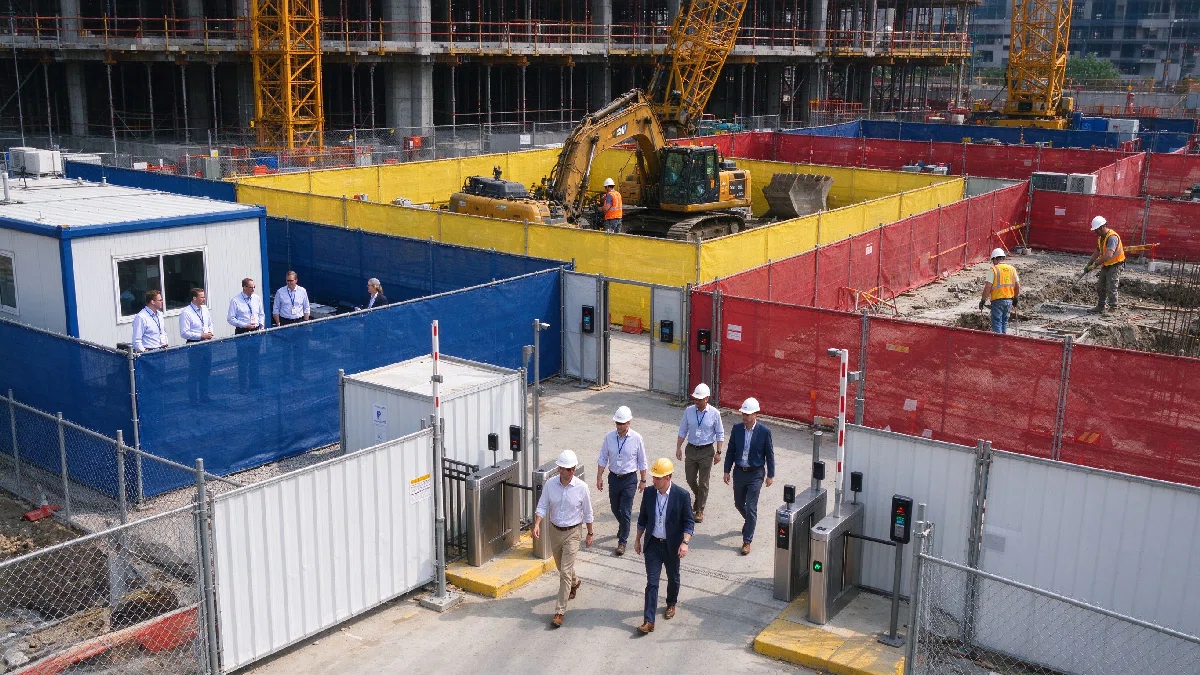
A more practical approach is to divide the project into functional security zones.
For example, a project may include:
Zone A — Main Pedestrian Entrance
Used by registered workers and approved project personnel.
Zone B — Project Administration Area
Used by project managers, engineering teams and office staff.
Zone C — Equipment and Machinery Area
Limited to authorized operators and maintenance personnel.
Zone D — Restricted Construction Area
Accessible only to workers assigned to that stage of the project.
Zone E — Logistics and Material Delivery Area
Used by suppliers, logistics teams and approved delivery personnel.
This structure makes construction site entry management more flexible.
A contractor does not necessarily need permission to enter every area simply because they are authorized to enter the project.
Zone-based permissions allow project administrators to match physical entry rights with actual job responsibilities.
As construction progresses, these zones can also be modified without rebuilding the entire security architecture.
4. Manage Contractor Entry by Time and Project Phase
Contractors are one of the biggest differences between construction projects and conventional commercial buildings.
Their permissions frequently change.
Consider an electrical contractor working during the installation stage. The team may need access for several weeks and then leave the project completely.
Providing permanent credentials would create unnecessary administrative work and potentially leave outdated permissions active.
A better contractor entry management strategy can use time-based authorization.
Permissions can be associated with working hours, project phases, specific zones or expiration dates.
For example, a subcontractor could be authorized to enter:
Monday–Friday → 07:00–18:00 → Main Entrance → Zone C
When the contract period ends, the permission expires rather than remaining active indefinitely.
This approach can make temporary workforce management easier as contractor populations increase or decrease.
5. Choose Entrance Hardware That Can Move With the Project
Construction environments create challenges that do not normally exist inside finished office buildings.
Equipment may be exposed to dust, rain, temperature changes, temporary power arrangements, equipment movement and frequent changes to the surrounding site layout.
Therefore, hardware selection should reflect the actual installation environment.
For outdoor or semi-outdoor locations, system integrators should evaluate enclosure protection, operating temperature, mounting methods, power requirements, communication interfaces, physical protection and maintenance access.
The same principle applies to authentication equipment.
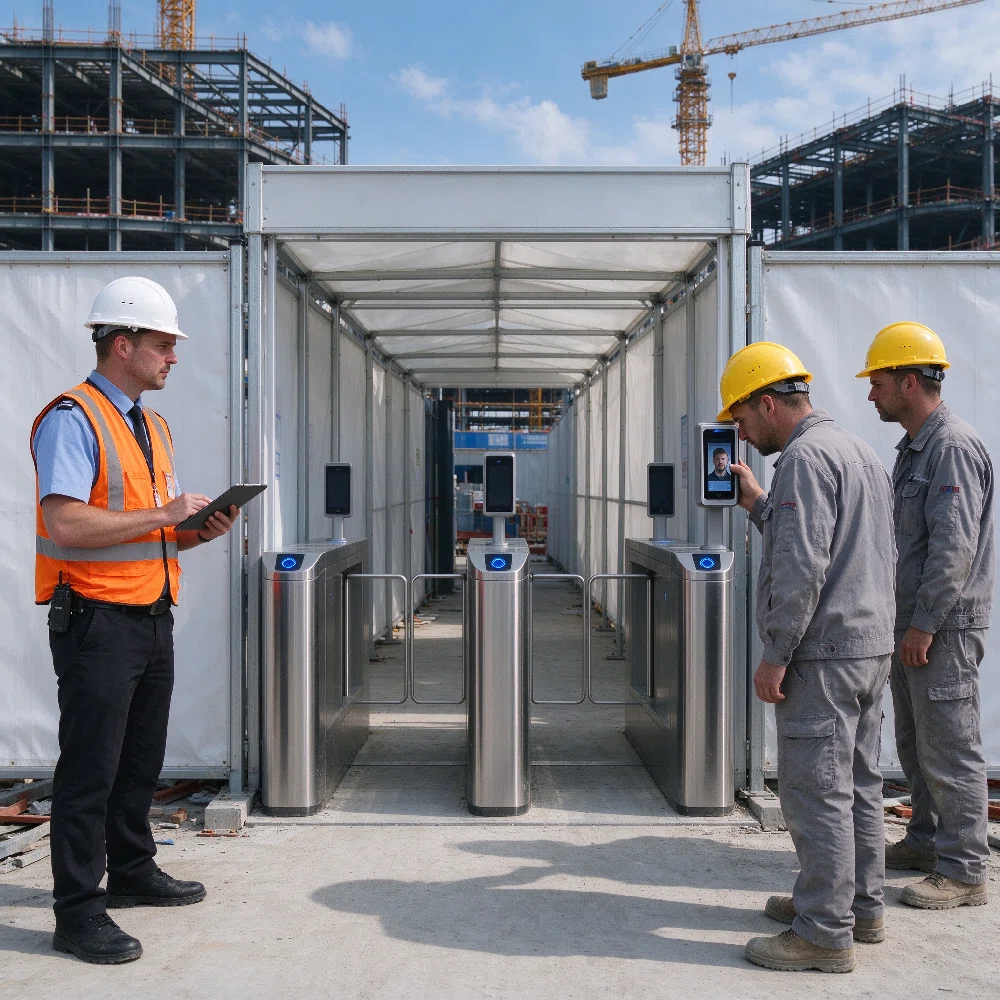
A facial recognition terminal installed at a construction entrance should be evaluated according to lighting, mounting position, weather exposure and expected user flow.
For environments with difficult lighting conditions, understanding WDR technology for outdoor facial recognition can help integrators evaluate whether a terminal is appropriate for entrances affected by sunlight, shadows or strong backlighting.
The physical entrance equipment should also be selected with future relocation in mind.
New Auto’s pedestrian entrance products can be evaluated according to lane configuration, installation environment and project requirements.
6. Plan Network Connectivity Before Installing Equipment
Temporary construction sites may not have the network infrastructure available in completed commercial buildings.
That makes connectivity an important part of construction site entrance planning.
Before equipment installation, the integrator should determine whether Ethernet is available, whether Wi-Fi coverage is reliable, where controllers will be installed, and whether remote management is required.
The project should also define what happens if communication is interrupted.
For example, does the authentication terminal require constant communication with a central server?
Can authorization continue locally during a network interruption?
How are event records synchronized after connectivity returns?
These questions should be answered during system design rather than after installation.
For larger projects, the entrance infrastructure may eventually need to communicate with other security, workforce or project-management platforms.
Planning for those interfaces early can reduce future integration work.
7. Design the Authentication-to-Entry Workflow
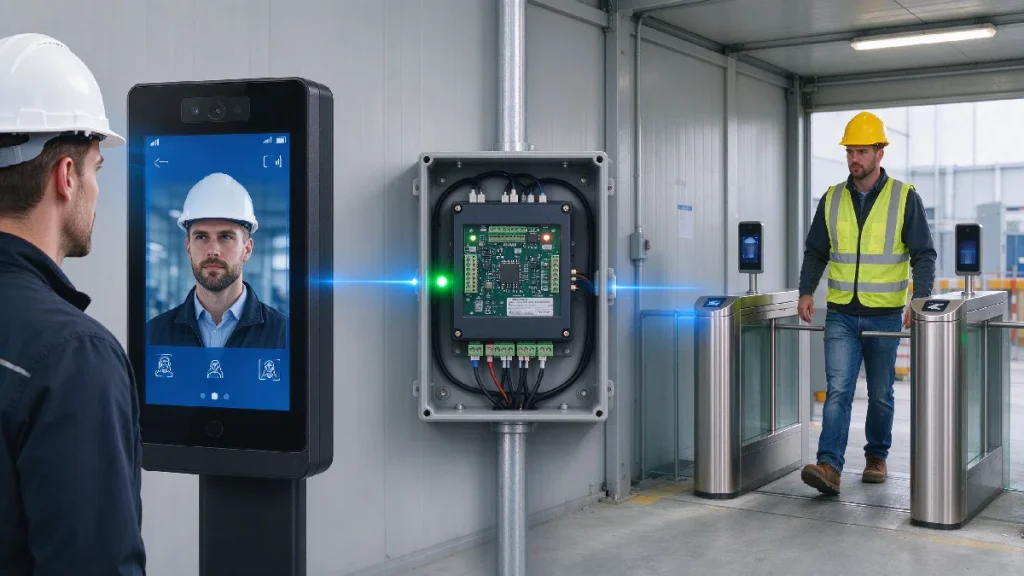
The authentication terminal and pedestrian gate should not be treated as two unrelated products.
They are parts of one operational workflow:
Identification → Authorization → Controller → Gate Command → Physical Passage → Event Record
The system integrator should determine where each decision occurs.
For example, the terminal may identify the worker, while a controller determines whether the credential has permission for that particular entrance.
Once authorization is confirmed, the controller sends the appropriate command to the pedestrian gate.
The event can then be recorded by the management platform.
NIST’s guidelines for physical access systems provide useful technical context for understanding identity verification and physical entry architectures.
For integrators connecting facial recognition terminals with pedestrian gates, New Auto’s facial recognition turnstile wiring guide also explains how terminals, controllers, relays and entrance equipment can work together.
This integration becomes especially important for temporary projects because equipment may later need to be moved to another entrance.
8. Separate Pedestrians From Construction Vehicles
Construction sites frequently handle pedestrians and heavy vehicles at the same time.
These two traffic flows should not automatically share the same entrance.
Workers may require controlled pedestrian entry, while trucks, construction machinery and delivery vehicles usually follow a different verification and routing process.
Separating pedestrian and vehicle movement can reduce congestion and help avoid conflicts around busy entrance areas.
It also makes the security workflow clearer.
A temporary pedestrian entrance system can therefore be designed specifically around worker authentication and pedestrian throughput, while vehicle entry follows a separate route appropriate to the project.
Physical separation is especially important during shift changes, when large numbers of workers may arrive at the same time as material deliveries.
9. Reduce Bottlenecks During Worker Shift Changes
Security is not the only consideration at a construction entrance.
Throughput matters too.
A system that works well for 50 workers may produce long queues when 500 people arrive within a short shift-change period.
Project planners should therefore evaluate peak traffic rather than average daily traffic.
Important factors include the number of workers arriving within the busiest period, authentication time, number of pedestrian lanes, gate opening speed and the space available before and after the entrance.
The objective is to create a predictable pedestrian flow.
For higher-volume sites, multiple lanes may be more effective than forcing all workers through one heavily used entrance.
Authentication methods should also be selected according to the project environment.
Facial recognition, cards, QR credentials or combinations of different methods can be considered depending on the user group and project requirements.
10. Temporary Site Security Should Still Reflect Actual Risk
“Temporary” should never automatically mean “low security.”
A construction project may contain expensive machinery, building materials, electrical equipment, sensitive project documents, tools and restricted working areas.
Some zones may also present safety risks to people who are not trained or authorized to enter them.
A temporary construction site security strategy should therefore match entry requirements to the actual risk of each area.
General areas may require standard worker authentication.
Sensitive equipment areas may require stronger restrictions.
Temporary visitors may need limited permissions.
High-risk construction zones may require authorization based on worker role or project phase.
For environments where stronger identity verification is required, liveness detection and anti-spoofing technology can be considered when evaluating facial authentication equipment.
The objective is not to apply maximum security everywhere. It is to apply the appropriate level of verification to each environment.
11. Design for Changing Site Conditions
One of the most important characteristics of good construction site entry management is adaptability.
During project planning, ask:
What happens when the main entrance moves?
What happens when another subcontractor joins the project?
What happens when the number of workers doubles?
What happens when a temporary office is relocated?
What happens when a restricted area becomes available for general access?
If every change requires rebuilding the entire entrance system, the original architecture was probably too rigid.
Modular hardware, flexible permissions and clearly defined communication interfaces can make expansion and relocation easier.
This is particularly valuable for system integrators responsible for projects that develop over several construction phases.
12. Plan What Happens to the Equipment After the Project
Temporary security equipment should have a lifecycle plan.
When a construction project finishes, terminals, controllers and pedestrian gates do not necessarily need to be discarded.
Depending on their design, they may be relocated to another entrance, reconfigured for a completed building, stored for another project or redeployed at a different construction site.
This makes reusability an important procurement consideration.
For OEM buyers and system integrators, hardware configuration may also need to reflect installation dimensions, mounting requirements, communication interfaces and project-specific appearance.
New Auto’s OEM/ODM project support provides additional information for buyers evaluating customized project configurations.
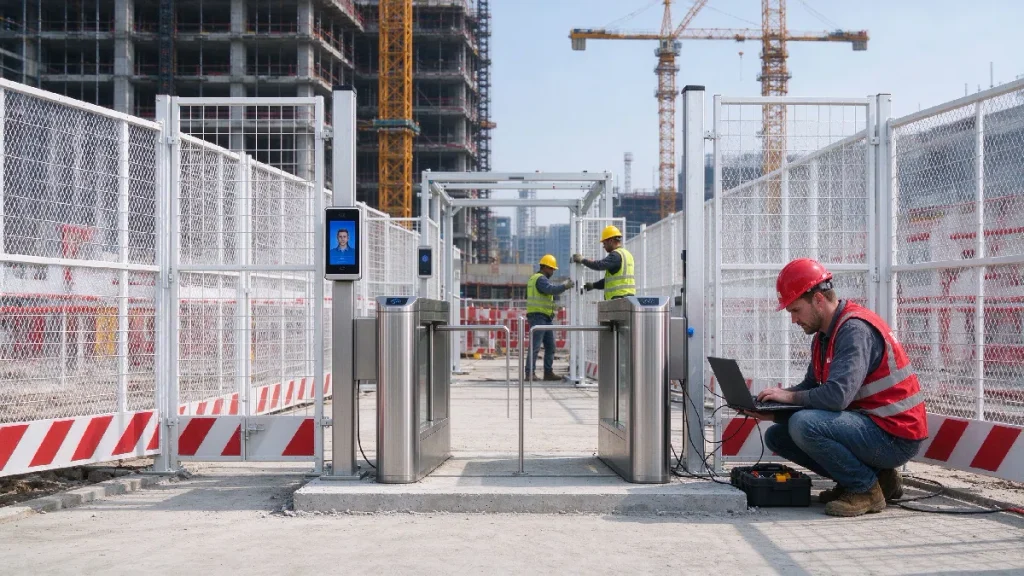
13. A Practical Construction Site Entry Planning Framework
Before equipment is selected, system integrators can organize project requirements into six areas.
| Planning Area | Questions to Confirm |
|---|---|
| Site | How many entrances are required? Which locations are indoor, outdoor or temporary? |
| Users | How many employees, contractors, subcontractors, suppliers and visitors will use the site? |
| Permissions | Are permissions based on time, project phase, work zone or user role? |
| Authentication | Will workers use facial recognition, cards, QR credentials or another method? |
| Infrastructure | What power, Ethernet, Wi-Fi, controller and communication interfaces are available? |
| Operations | How will logs, emergency procedures, maintenance, relocation and equipment reuse be managed? |
This framework helps move the conversation away from simply asking which gate or terminal to buy.
Instead, the project begins with operational requirements and then selects technology that fits those requirements.
That is the central principle behind effective construction site entry management.
Conclusion
Construction projects require an entrance strategy that can change together with the site.
Unlike permanent buildings, temporary projects may have rotating contractors, changing work zones, relocated entrances, temporary network infrastructure and rapidly changing worker populations.
Effective construction site entry management therefore requires more than installing a terminal and pedestrian gate.
Project teams should evaluate user groups, contractor schedules, security zones, authentication methods, physical entrance design, connectivity, peak worker traffic and future equipment relocation as one connected system.
A well-designed construction site entrance system can help project teams maintain controlled entry while remaining flexible enough to support different phases of construction.
For system integrators, the most important objective is not to create a permanent solution for a temporary environment.
It is to create an adaptable entrance architecture that can evolve from the first stage of construction to final project completion—and, where appropriate, be reused on the next project.
FAQ
What is construction site entry management?
Construction site entry management is the process of controlling and organizing how workers, contractors, visitors and suppliers enter a construction project. It can include identity verification, time-based permissions, work-zone restrictions, pedestrian entrance equipment and entry-event records.
How should contractor entry be managed on a construction site?
Contractor permissions can be assigned according to project phase, working hours, authorized zones and expiration dates. This allows permissions to change as different contractors join or leave the project.
Can facial recognition be used for construction worker entry?
Yes, facial recognition can be considered for construction sites when the installation environment, lighting, connectivity, privacy requirements and project authentication policies are suitable. Outdoor deployments should also consider weather protection and changing lighting conditions.
Should construction workers and visitors use the same entrance?
Not necessarily. Separating workers, visitors, suppliers or contractors can simplify entry procedures when these groups require different authentication or authorization processes.
How can construction sites reduce queues during shift changes?
Projects can analyze peak worker arrival rates, provide sufficient pedestrian lanes, reduce unnecessary authentication steps and ensure the gate configuration can support expected peak traffic.
What should be considered when choosing a temporary pedestrian entrance system?
Important factors include expected pedestrian volume, installation environment, available space, authentication method, weather exposure, network connectivity, power supply, emergency requirements and future relocation.
Can temporary entrance equipment be reused after a project ends?
Depending on the hardware and installation design, authentication terminals, controllers and pedestrian gates may be relocated, reconfigured or reused on another project.
Why is zone-based entry useful on construction sites?
Zone-based permissions allow workers and contractors to enter only the areas required for their responsibilities. This is useful when different parts of a construction project have different operational or security requirements.