Introduction
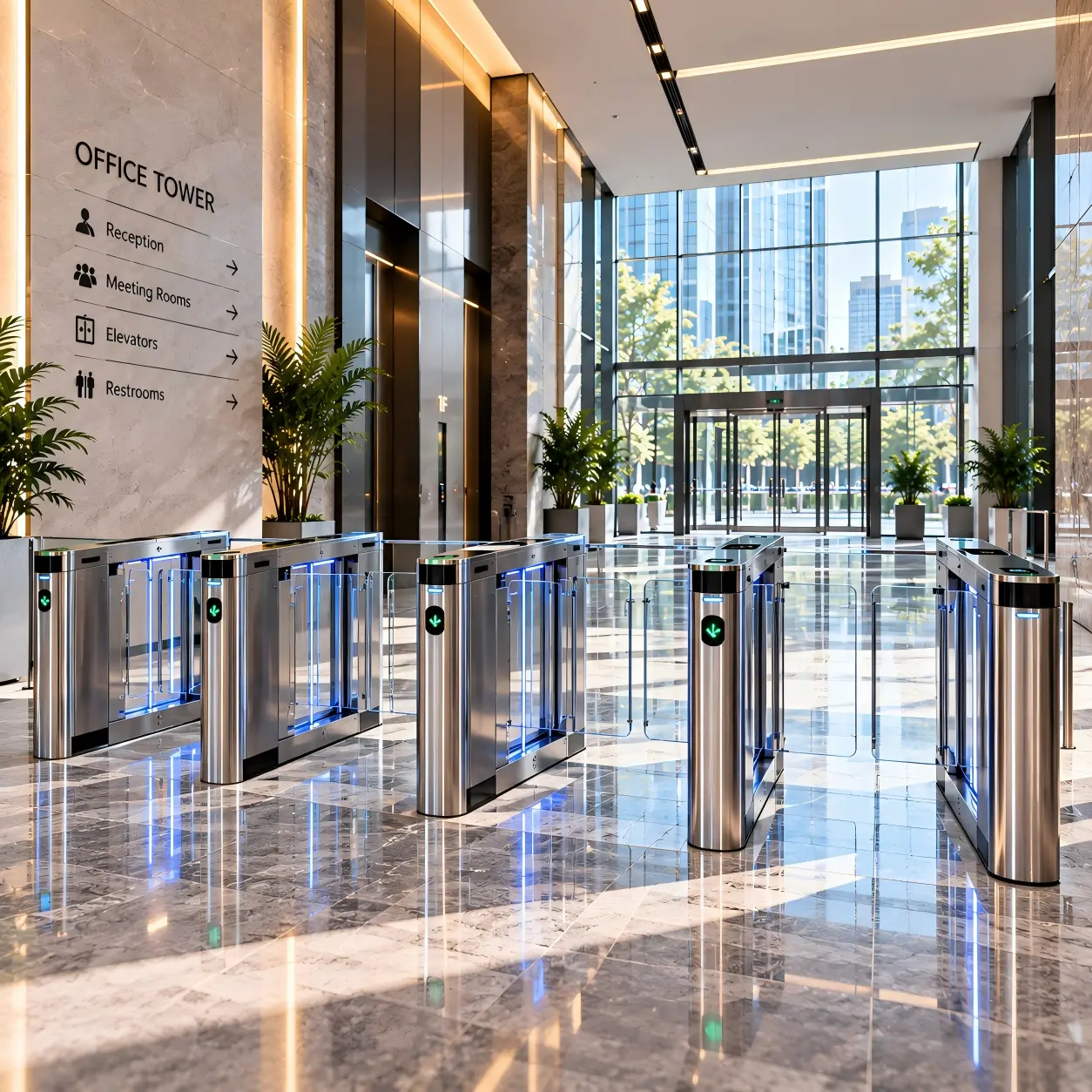
Modern pedestrian entrance projects are no longer built around a turnstile alone.
A physical access control system combines
authentication and authorization with controlled
entry points such as doors, security gates and
turnstiles.
For offices, factories, airports, campuses and other commercial facilities, the physical gate is only one part of the complete access control system. Identification devices, access control software, visitor management platforms and third-party applications may all need to communicate with the entrance equipment.
This is why turnstile access control integration has become an important consideration for project owners, security contractors and system integrators.
A well-integrated turnstile can receive authorization from an external access control system, release the lane for an approved user and send passage information back to the management platform.
For system integrators, understanding this relationship before selecting hardware can reduce compatibility problems and make project deployment easier.
What Is Turnstile Access Control Integration?
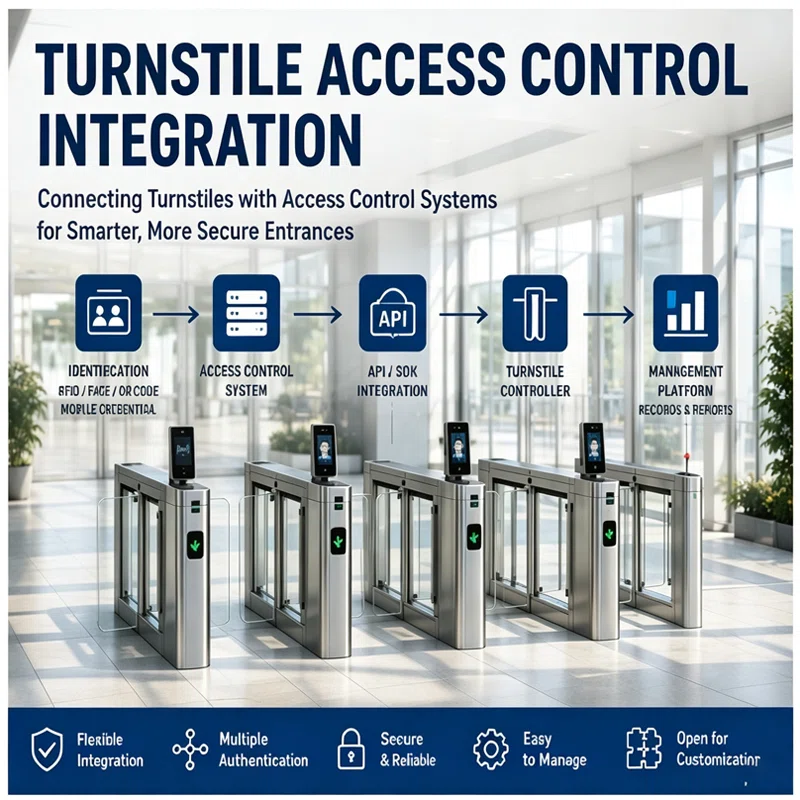
Turnstile access control integration means connecting a pedestrian entrance gate with an external access control system.
The turnstile normally performs the physical passage function, while the access control platform determines whether a person should be allowed to enter.
A typical process can be understood as:
User identification
        ↓
Reader / Terminal
        ↓
Access Control System
        ↓
   Authorization
        ↓
Turnstile Controller
        ↓
   Gate Opens
        ↓
Passage Feedback
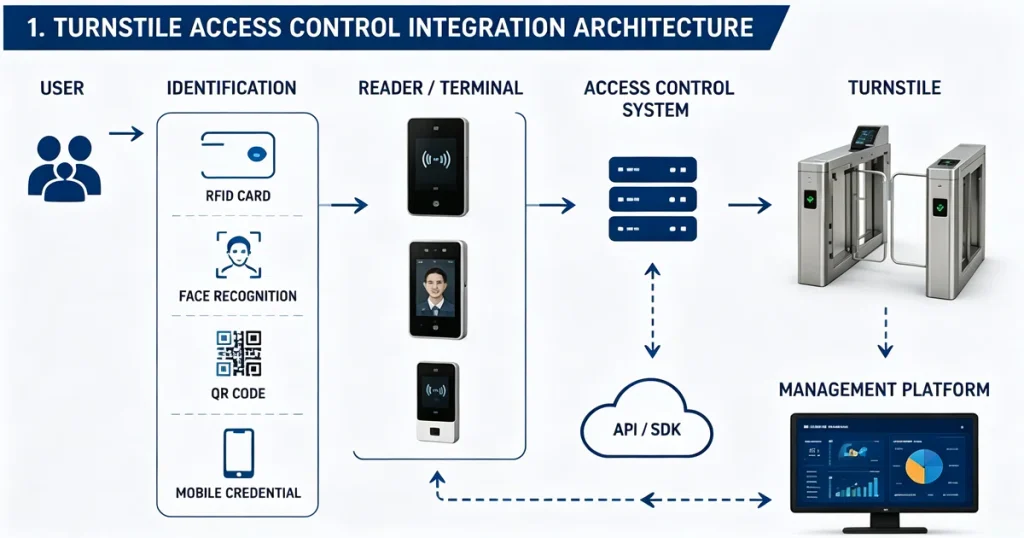
This architecture allows the turnstile to work with different identification methods.
Depending on the project, authentication can include:
- RFID cards
- Facial recognition
- QR codes
- Mobile credentials
- Biometric authentication
- Other third-party readers
The exact integration method depends on the hardware, controller and software architecture selected for the project.
Why System Integration Matters
1. Existing Access Control Systems
Many projects already have an access control platform in place.
Replacing the entire system simply because a new turnstile is required may increase project cost and deployment complexity.
An integration-friendly turnstile can allow the existing access control platform to remain responsible for user authorization while the turnstile provides physical pedestrian control.
This approach can be especially useful when upgrading entrances in existing buildings.
2. Multiple Authentication Technologies
Different entrances may require different identification methods.
For example:
Office lobby
→ RFID or mobile credential
Factory employee entrance
→ RFID
High-security area
→ Facial recognition or biometric authentication
Visitor entrance
→ QR code or visitor management system
The physical entrance equipment should therefore support the project’s required reader and communication architecture.
How Does a Turnstile Connect to an Access Control System?
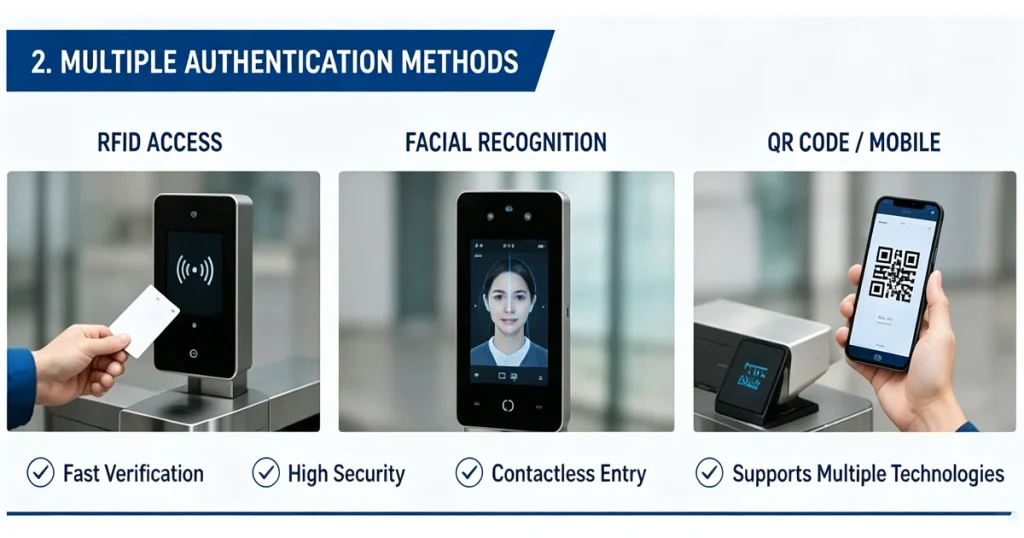
A typical integration contains several layers.
Layer 1: Identification
The user presents a credential.
For example:
- RFID card
- Face
- QR code
- Mobile credential
The reader or terminal verifies the user’s identity.
Layer 2: Access Control Decision
The access control platform checks:
- Is the user registered?
- Does the user have permission?
- Is the credential valid?
- Is the user allowed to enter this area?
If authorization is successful, the system sends an opening command.
Layer 3: Turnstile Control
The turnstile controller receives the authorized signal and releases the lane.
The user can then pass through.
Layer 4: Passage Feedback
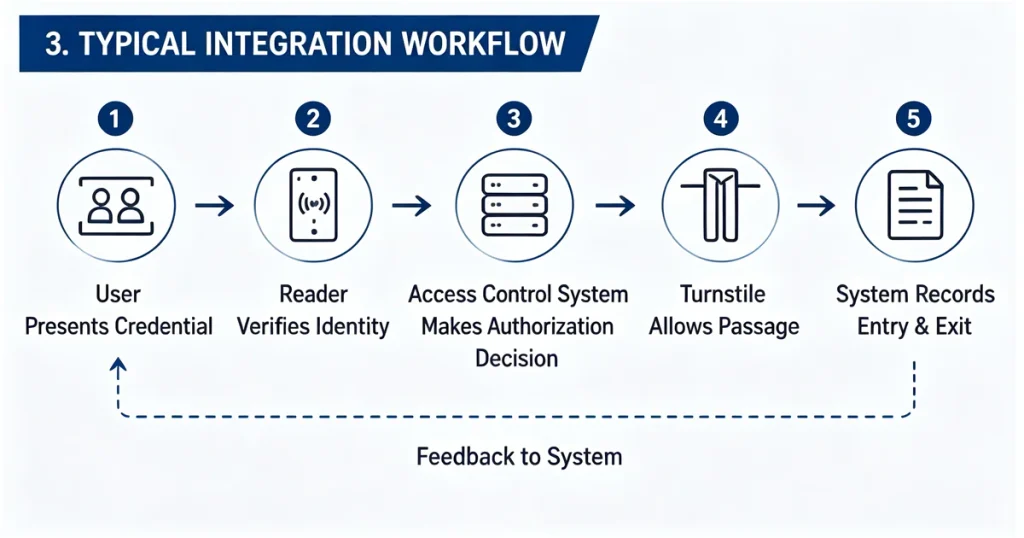
After the user passes, the system can receive information about the passage.
This allows the management platform to maintain access records and support security monitoring.
What Should System Integrators Check Before Deployment?
This is one of the most important parts of the project.
Before purchasing a turnstile, system integrators should confirm the communication interfaces and integration requirements.
Communication Interface
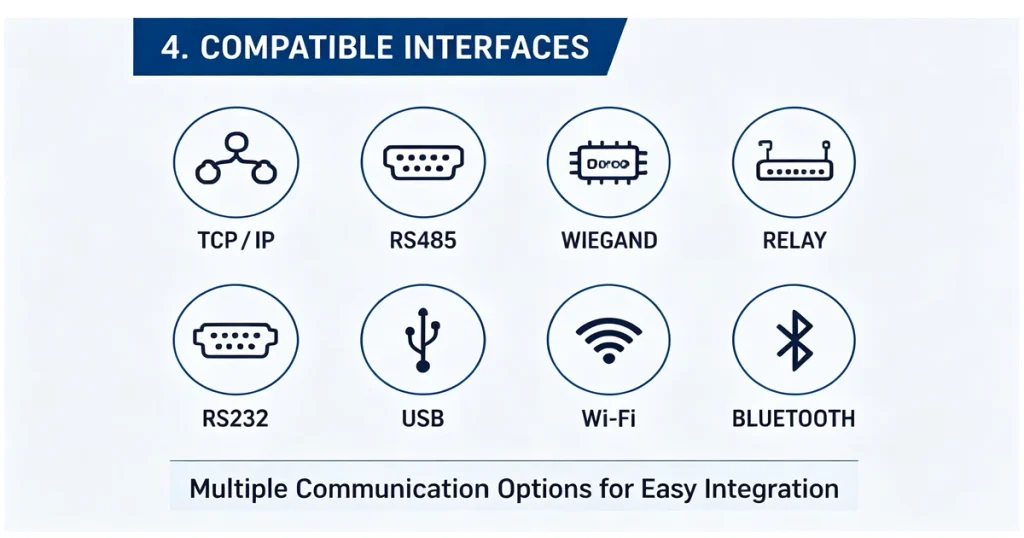
Check whether the equipment supports the communication methods required by the project.
Depending on the product, interfaces may include:
- TCP/IP
- RS485
- Wiegand
- Relay
- USB
- Other control interfaces
For example, New Auto Element’s NAT-V5 Pro facial recognition terminal supports TCP/IP, Wi-Fi, Bluetooth, relay, Wiegand input/output and RS232, providing multiple options for system integration.
For a different project, the required interface may be different.
Therefore, integrators should confirm compatibility before placing an order.
Turnstile API Integration
For projects requiring software-level integration, API or SDK support can become particularly important.
Because APIs can expose application functions and sensitive data, system integrators should also consider API security during implementation.
An API can allow external software to communicate with the access control equipment.
Possible applications include:
- HR systems
- Attendance systems
- Visitor management
- Building management
- Security platforms
- Customized enterprise software
Instead of operating as an isolated entrance device, the turnstile can become part of a larger intelligent access control ecosystem.
RFID Integration
RFID remains a practical technology for many employee entrances.
RFID-enabled authentication can be used for building access, including turnstiles, and can also support other workplace access scenarios.
A common architecture is:
RFID Card
    ↓
RFID Reader
    ↓
Access Control Controller
    ↓
 Turnstile
The reader identifies the credential, while the access control system determines whether access should be granted.
This makes RFID particularly suitable for:
- Factories
- Warehouses
- Office buildings
- Industrial parks
- Employee entrances
For more information about RFID applications, see our guide on RFID access control turnstiles.
Facial Recognition Integration
Facial recognition can provide another authentication option.
Instead of requiring users to carry cards, the system can verify the user’s face before releasing the entrance.
This can be useful for:
- Smart office buildings
- Manufacturing facilities
- High-security areas
- Smart campuses
- Enterprise entrances
New Auto Element’s facial recognition terminals are designed with multiple communication interfaces and can support integration with broader access control systems.
For projects requiring dynamic facial recognition, edge processing and system integration should also be considered during the solution design stage. New Auto Element’s existing technical content highlights API/SDK support and multi-device interoperability as vendor evaluation factors.
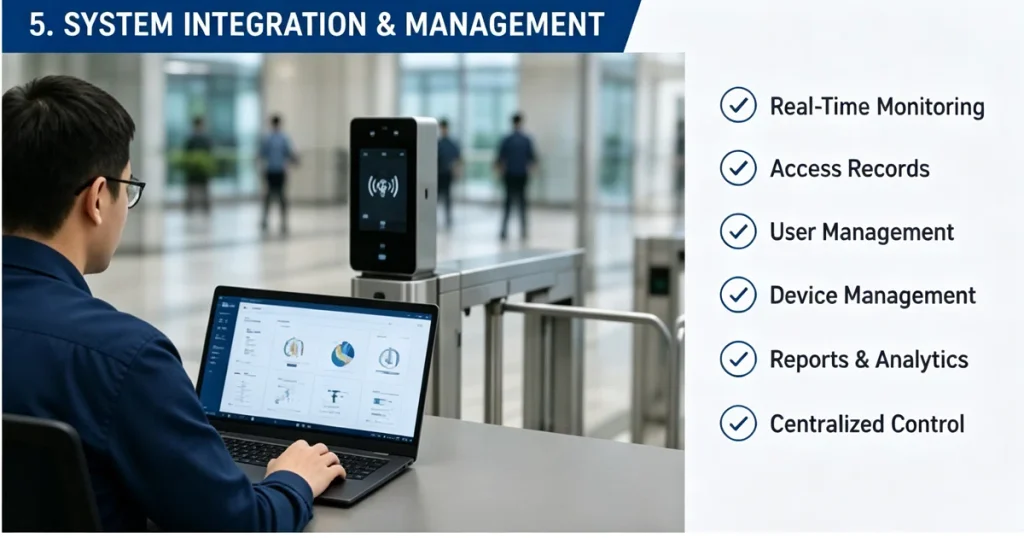
Visitor Management Integration
Modern entrance systems may also need to support visitors rather than employees only.
A typical visitor workflow could be:
Visitor Registration
         ↓
Identity Verification
         ↓
Visitor Credential / QR Code
         ↓
Access Authorization
         ↓
    Turnstile
         ↓
   Entry Record
This allows companies to manage temporary visitors without giving them permanent employee credentials.
It can be particularly useful for:
- Corporate offices
- Factories
- Industrial parks
- Campuses
- Commercial buildings
Integration With Different Turnstile Types
Different entrance products can be connected to access control systems.
Smart Speed Gates
Best suited for:
- Corporate offices
- Modern buildings
- Headquarters
- High-traffic entrances
They prioritize both security and pedestrian flow.
For more information, see our article about smart speed gate systems.
RFID Turnstiles
Suitable for:
- Employee entrances
- Factories
- Warehouses
- Industrial facilities
They provide straightforward credential-based access.
Facial Recognition Turnstiles
Suitable for projects requiring:
- Contactless authentication
- Biometric identification
- Smart entrance management
Full Height Turnstiles
Full height turnstiles provide stronger physical protection and are suitable for restricted or outdoor areas.
They can be combined with RFID, biometric or other access control technologies depending on project requirements.
Why Choose an Integration-Friendly Turnstile Manufacturer?
Choosing a turnstile supplier only according to appearance or price can create problems later.
For system integrators, the supplier should also be evaluated according to:
- Hardware compatibility
- Communication interfaces
- SDK/API capability
- Customization
- Manufacturing capability
- Technical support
- Project experience
- OEM/ODM capability
New Auto Element provides smart pedestrian access control products and customized integration solutions for global projects.
Its product portfolio includes speed gates, swing barriers, flap barriers, facial recognition terminals and other pedestrian entrance solutions.
Conclusion
Turnstile access control integration is an important part of modern entrance security projects.
The turnstile provides the physical barrier, while identification devices, access control platforms and software determine how users are authorized and managed.
For system integrators, the most important step is to define the project architecture before selecting hardware.
Communication interfaces, reader compatibility, API/SDK requirements, emergency behavior and future scalability should all be considered.
A well-designed integration can allow different technologies—including RFID, facial recognition, visitor management and smart turnstiles—to work together as one entrance control solution.
New Auto Element provides customized smart access control and turnstile integration solutions for global projects.
Contact New Auto Element to discuss your access control integration requirements.
FAQ
What is turnstile access control integration?
Turnstile access control integration connects a pedestrian turnstile with an access control system so that user identification, authorization and physical entry can work together.
Can turnstiles work with third-party access control systems?
Yes. Depending on the turnstile and controller, third-party access control systems can be connected through interfaces such as TCP/IP, RS485, Wiegand, relay or other supported communication methods.
Can RFID readers be integrated with turnstiles?
Yes. RFID readers can be integrated with turnstiles to verify employee credentials and allow authorized users to enter factories, offices, warehouses and other controlled areas.
What is the role of an API in turnstile integration?
An API allows external software platforms to communicate with compatible turnstile or access control equipment. It can be used for customized applications such as visitor management, attendance, security platforms and building management systems.
Do system integrators need SDK support for turnstile projects?
SDK support can be useful when a project requires customized software integration. It allows developers and system integrators to build applications around supported hardware functions and communication capabilities.
Which turnstile is suitable for a smart building?
Smart speed gates are commonly suitable for modern office buildings and commercial entrances where security, pedestrian flow and appearance are important.
Can turnstiles integrate with visitor management systems?
Yes. A turnstile can be incorporated into a visitor management workflow where visitors are registered, authenticated and authorized before the entrance is released.
What should system integrators check before selecting a turnstile?
System integrators should check communication interfaces, reader compatibility, API or SDK availability, third-party integration requirements, emergency functions, customization options and technical support.
Can New Auto Element provide customized turnstile integration solutions?
Yes. New Auto Element provides customized smart access control and pedestrian entrance solutions for global projects, including turnstiles, RFID access control, facial recognition and system integration requirements.