


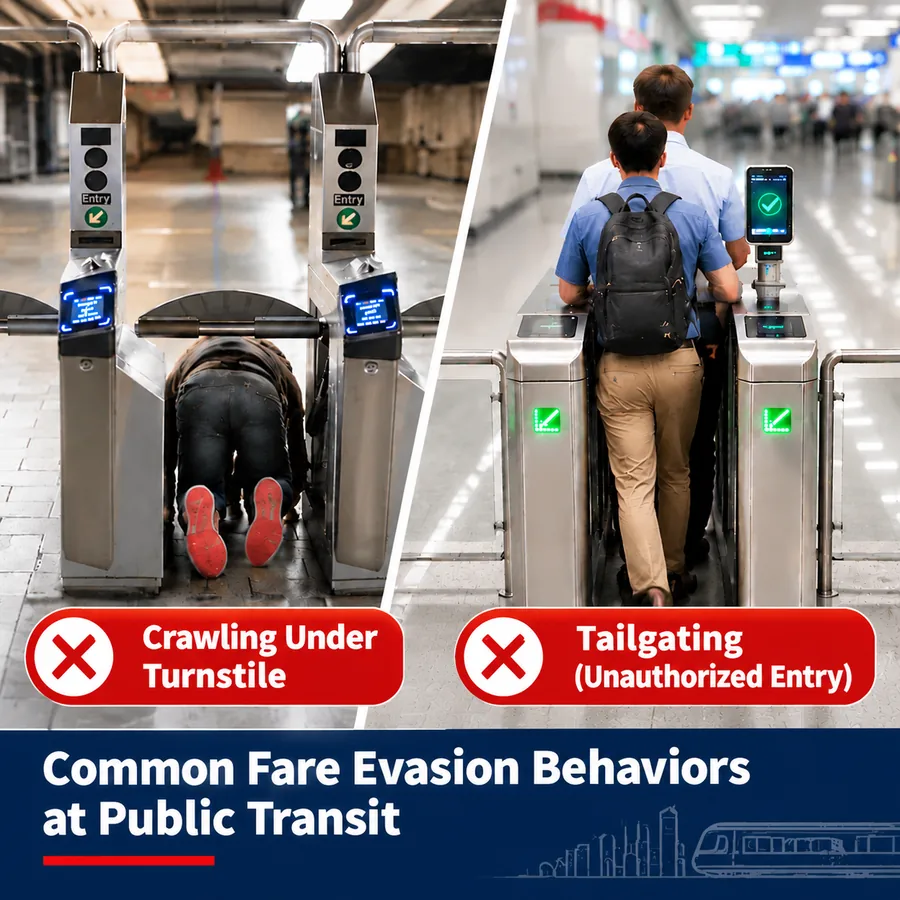
An authorized passenger enters a gate, and a second person follows so closely that the entrance equipment treats both movements as one. In other situations, someone attempts to crawl under a turnstile or enter against the permitted direction. These are not simply ticketing inconveniences: they expose a gap between verifying a credential and verifying what actually happens inside the lane.
For railway operators, facility managers and security integrators, an anti-tailgating turnstile system must connect passage sensing, gate behavior and the existing authorization process. NewAutoT’s proposed approach combines multi-point infrared detection and millimeter-wave (mmWave) radar sensing, with an optional AI camera for event images and recording. The camera is not required for the core infrared-and-radar detection architecture.
How Does an Anti-Tailgating Turnstile Work?
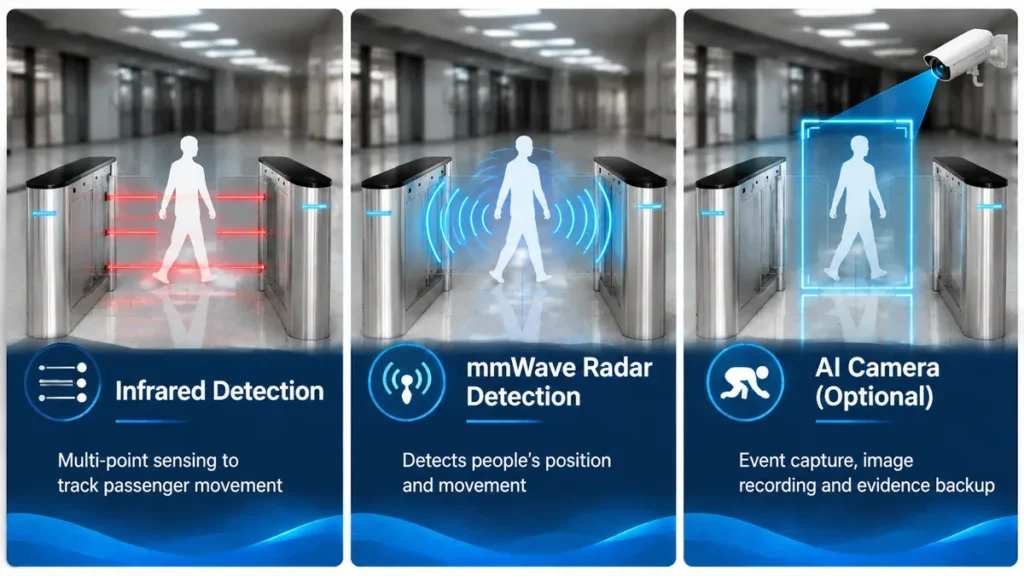
An anti-tailgating turnstile system monitors the sequence and movement of people inside a pedestrian lane after an authorized entry. Infrared sensing zones track passage events; mmWave radar adds movement and position information. Project-specific control logic compares these signals to flag suspected close-following or abnormal passage. Optional cameras can help document an incident. Detection, alarm actions and gate responses must be configured and tested for the actual lane and operating conditions.
1. The Problem: One Credential Does Not Always Mean One Person
Conventional entry control can confirm a valid ticket, card or biometric credential and then release a gate. It does not necessarily establish that exactly one person has passed. A closely following second person may exploit the opening window, especially at busy stations or entrances where staff cannot watch every lane continuously.
Common scenarios include close-following behind a paying passenger, two people attempting to pass on a single authorization, crawling beneath a barrier, wrong-direction entry and lingering within a gate lane. These behaviors differ, so a single sensor threshold or a faster gate motor is unlikely to address every case.
For a station, the aim is to reduce fare-evasion opportunities while preserving orderly throughput. For an office, industrial site or data center, the priority may be unauthorized entry prevention and auditable incident handling. The design must follow the real operational risk rather than a generic marketing promise.
2. Core Detection: Infrared Passage Logic
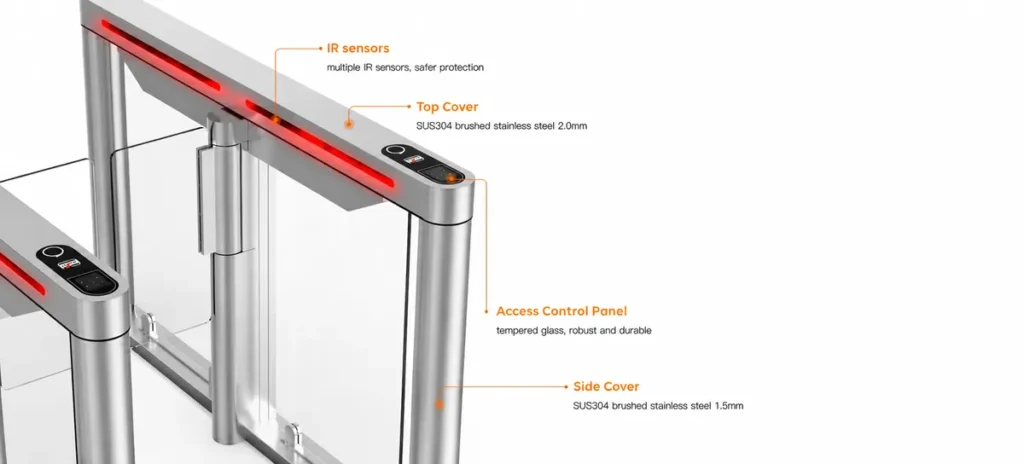
Multiple infrared detection points can divide the gate lane into sensing zones. The controller interprets the order in which beams or zones change state, including entry direction, occupancy and the expected sequence of passage. This makes the placement of sensors and the timing logic as important as the hardware itself.
For a one-way lane, the detection rules can be tuned to the normal entrance sequence. For a bidirectional lane, the design must distinguish legitimate reverse movement from abnormal behavior. Sensor coverage should also account for gate width, barrier geometry, luggage and different walking speeds.
Infrared sensing is useful for defining passage events, but occlusion, closely spaced people and unusual movement can complicate interpretation. That is why NewAutoT’s source solution proposes cross-checking infrared observations with radar data rather than relying on a single sensing channel.
3. mmWave Radar Adds Movement and Position Context
Millimeter-wave radar can provide additional information about the position and motion of people within a configured detection area. In the proposed architecture, that information complements the infrared sequence and helps the control logic evaluate suspected close-following behavior.
Radar sensing is not dependent on visible lighting in the same way as an optical camera. However, actual detection quality still depends on installation height, orientation, reflectivity, nearby structures, multipath effects, crowd density and parameter tuning. No sensor should be described as infallible or immune to every environmental condition.
For procurement, request a site-specific demonstration that includes close-following at different spacings, normal single-person passage, people carrying bags and the busiest expected operating period. A useful acceptance test measures both missed events and nuisance alarms.
4. Optional AI Cameras: Event Evidence, Not Mandatory Detection Hardware
An AI camera can be added for exception snapshots, video recording or supporting review by security personnel. This is especially useful where an operator needs evidence to investigate a suspected fare-evasion or unauthorized-entry event.
The uploaded NewAutoT proposal explicitly treats the camera as optional. The base detection concept uses infrared and mmWave radar; camera functions should therefore be quoted separately, along with storage, retention policy, network bandwidth and privacy obligations. Camera footage does not automatically prove intent or establish that a violation occurred.
5. Sensor Fusion: How the Passage Decision Is Made
A practical system does not simply combine three devices and assume that performance improves. Integrators must define the passage state machine: authorized entry received, lane occupied, expected movement sequence observed, passage completed, or an abnormal sequence detected. The controller then determines whether to log, notify, alarm or trigger an approved gate response.
Infrared and radar information can be cross-checked to reduce some false positives and missed events, but the final result depends on the quality of the rules and calibration. Distinguish between a suspected tailgating event, a confirmed authorization mismatch and a physical safety hazard; these are not interchangeable states.
The system should also record timestamps, lane ID, authorization reference where permitted, event type and device status. Where video is enabled, associate footage with the event according to the customer’s data-protection policy. For a broader discussion of connected devices and project interfaces, see NewAutoT’s AI entrance management solution.
6. Configuring Lanes for Real Projects
One-way and bidirectional lanes
One-way entrance lanes generally have a simpler expected movement sequence. Bidirectional lanes require clear direction handling and protection against overlapping traffic. The sensor count, mounting locations and timing rules should be determined from lane drawings and a site survey, not from a universal sensor-count claim.
Gate design and user behavior
Flap barriers, swing gates, speed gates and tripod turnstiles have different barrier shapes and passage behaviors. A wider accessible lane must accommodate wheelchair users and mobility aids without classifying legitimate movement as suspicious. Luggage, children accompanying adults and maintenance operations also require explicit rules.
Peak-hour throughput
A stricter detection policy may increase alarms or slow entry if it is not tuned correctly. Test throughput and exception handling together. Queue length, response time, staff intervention and recovery after an alarm are as important as the initial detection event.
7. Radar-Triggered Opening Is a Separate Optional Function
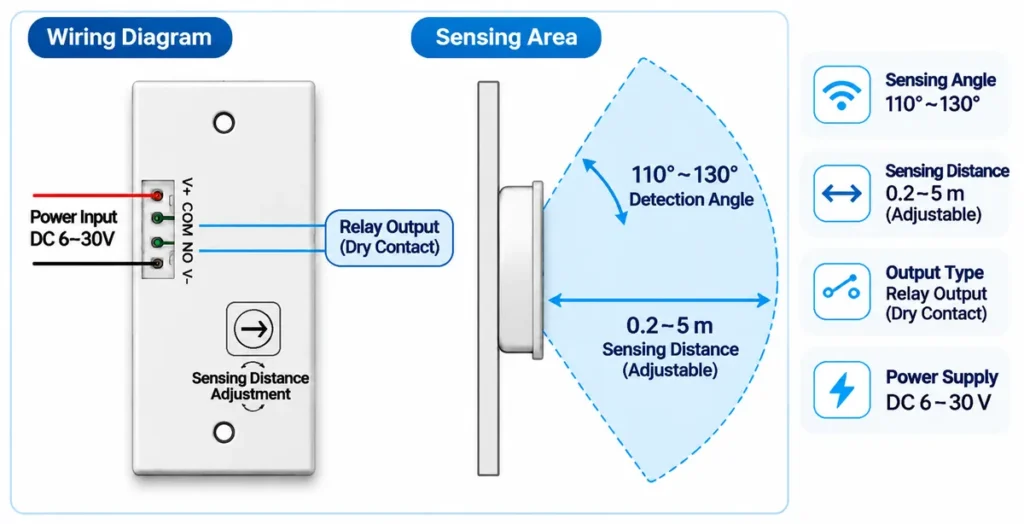
The supplied technical illustration shows a radar activation sensor with a reference sensing angle of 110°–130°, adjustable sensing distance of 0.2–5 m, DC 6–30 V power and a dry-contact relay output. These are reference specifications for the illustrated opening-trigger sensor, not verified performance figures for the entire anti-tailgating system.
Radar-triggered gate opening can be considered for applications where an authorized passage workflow permits automatic triggering. It must not bypass ticket validation or replace anti-tailgating detection. At a transit station, the ticketing or credential system remains the authority for entry; the radar sensor alone is not a fare-validation device.
8. Integration Checklist for System Integrators
Before ordering, confirm the host gate controller, ticketing or identity platform, passage sensors and alarm outputs. NewAutoT’s proposal mentions gate logic configuration, optional radar-triggered opening, optional camera integration, Bluetooth-related configuration and interfaces including MQTT and HTTP. The exact protocols, electrical levels, event fields and supported commands must be confirmed for the selected product and firmware.
Define the authorization source, relay or communication interface, abnormal-passage handling, local event storage, power-loss behavior and network-failure response. Also document how the gate behaves during emergency egress and whether any applicable fire, accessibility or machine-safety requirements constrain the design.
A dry-contact relay should not be treated as a universal connection diagram. Verify terminal assignments, supply voltage, contact ratings, isolation, protective devices and the controller manual before installation. The illustrated wiring image is for reference only.
NewAutoT provides pedestrian gate hardware, facial recognition terminals and project integration support. The company can discuss lane sensing layouts, controller logic and OEM/ODM requirements through its engineering and service page.
9. Where Anti-Tailgating Systems Are Useful
Metro, railway and high-speed rail stations
Transit projects focus on discouraging fare evasion and handling large passenger volumes. Integration with the existing ticketing platform and a reliable exception workflow are essential; the proposed system should not be represented as a stand-alone replacement for fare collection.
Factories and industrial parks
Industrial sites may need to prevent unauthorized visitors from following employees into controlled production areas. Shift changes, PPE, delivery movements and local operating procedures affect sensor configuration.
Office buildings and enterprise campuses
Commercial properties may want more consistent entry rules without creating morning queues. Separate visitor workflows, wider accessible gates and event reporting can support practical operations.
Data centers and restricted rooms
High-security facilities may require stronger assurance that an authorized credential is not being shared through close-following. Additional physical controls, monitoring and incident response may be appropriate according to the risk assessment.
10. What Buyers Should Request Before Approving a Proposal
Ask for a lane layout drawing with sensor positions, a list of supported abnormal-passage scenarios, a demonstration plan, integration interface details, optional camera scope, alarm and logging rules, maintenance responsibilities and acceptance criteria. Compare proposed solutions on the full workflow rather than only the advertised sensing technology.
Relevant standards and guidance should be evaluated by the project owner and qualified engineers. The International Electrotechnical Commission and International Organization for Standardization provide standards resources, while local fire, building, accessibility and privacy requirements may also apply. These references are not endorsements or proof of product certification.
Conclusion: Build the Anti-Tailgating Logic Around the Lane
An effective anti-tailgating turnstile system is a coordinated entrance solution, not a single sensor or camera. NewAutoT’s proposed combination of infrared passage logic and mmWave radar provides two complementary sources of movement information, while optional AI video can support incident review. The final detection policy must be validated against actual lane geometry, traffic conditions and the customer’s authorization system.
Planning a station, office, factory or restricted-area entrance? Send NewAutoT your lane dimensions, one-way or bidirectional requirements, expected traffic, existing controller or ticketing interface and preferred alarm workflow. The team can discuss a suitable gate configuration and OEM/ODM integration scope. Contact NewAutoT for a project assessment.
常见问题
What is an anti-tailgating turnstile system?
It is an entrance system that monitors whether the actual passage through a controlled lane matches the expected authorized movement, using sensors and configured control logic.
Is an AI camera required for tailgating detection?
Not in the NewAutoT proposal described here. Infrared and mmWave radar form the primary sensing approach; an AI camera is an optional source of event imagery and recording.
Can radar sensing replace ticket validation?
No. A radar-triggered opening sensor is not a ticketing or identity-verification system. Authorization must remain under the appropriate credential or fare platform.
Can the solution be used for bidirectional gates?
Potentially, with a lane-specific sensor arrangement and control logic. The integrator must validate direction changes, overlapping passage and emergency operation.
Will sensor fusion eliminate all false alarms?
No. Combining sensing sources may improve decision-making, but performance depends on layout, calibration, conditions and acceptance testing.
What should I send to request a quotation?
Provide gate type, lane width, traffic direction, site photographs or drawings, existing authorization interface, expected daily and peak traffic, and any evidence-recording requirements.