


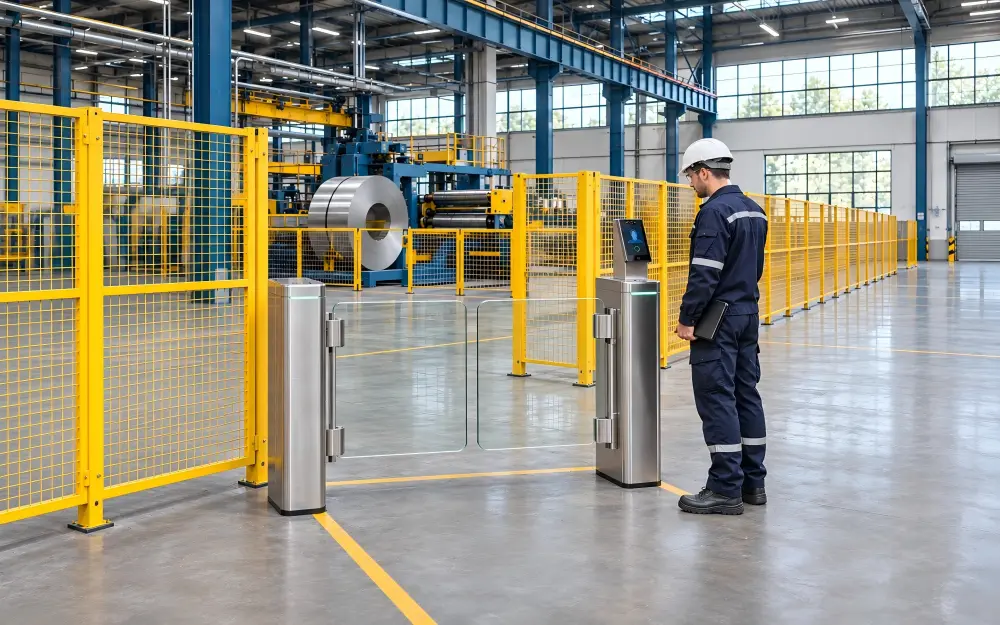
Factory maintenance involves more than identifying who can pass through a gate. Teams also need to know which work area a person is assigned to, whether a maintenance tag is still active, and which information must reach the equipment control system. When these records are kept separately, supervisors have to reconcile paper forms, gate logs and control-room updates.
An integrated approach connects personnel identification, controlled passage, electronic tagging software and agreed PLC status signals. NewAutoT provides facial recognition terminals, pedestrian turnstiles and electronic tagging software, together with project interface support. The configuration should follow the factory’s actual maintenance process and the capabilities confirmed for the selected equipment and software.
Quick Answer
A factory maintenance access control and electronic tagging system links a worker’s identity with authorized passage and a digital record of maintenance participation. It can exchange defined status signals with an existing programmable logic controller, or PLC, through compatible interfaces. Electronic tagging and access records support coordination; they do not independently prove that a machine is isolated, an area is clear or equipment is safe to restart.
What PLC Means in a Factory Maintenance Project
A PLC is a programmable logic controller: an industrial controller that reads inputs, executes a configured program and updates outputs. In a factory, it may receive sensor and switch signals and coordinate equipment operation through connected control devices.
For this application, the PLC belongs to the equipment control side of the project. The access terminal verifies identity, the gate manages pedestrian passage, and electronic tagging software manages the agreed digital maintenance-tagging process. The PLC receives only the information defined in the integration design and processes it within the customer’s control architecture.
Ordinary PLC equipment should not be assumed to provide a machine safety function. Siemens explains the additional fault detection and safe-state behavior of fail-safe automation systems; the complete application still requires appropriate engineering and validation.
What Electronic Tagging Adds to Access Control
An ordinary access log answers who presented a credential and when. Depending on the installation, a separate passage sensor may record whether someone actually crossed the lane. Neither event automatically describes that person’s maintenance responsibility.
In this article, electronic tagging means a digital workflow associating an identified worker with a defined maintenance area, equipment group or work assignment. A tagging operation registers participation under the approved procedure. An untagging operation records completion or withdrawal from that assignment according to the site’s rules. It is a management record, not a claim that a physical energy-isolating device has been locked or unlocked.
The project specification should define who may create or remove a tag, which area it belongs to, which conditions must be checked, and how exceptions are reviewed. For NewAutoT’s electronic tagging software, the required screens, permission rules, records, reports and integration points should be confirmed in the agreed software scope. Requirements for language, local deployment, additional approvals or third-party connections should be reviewed explicitly rather than assumed to be standard on every installation.
How the Main System Components Work Together
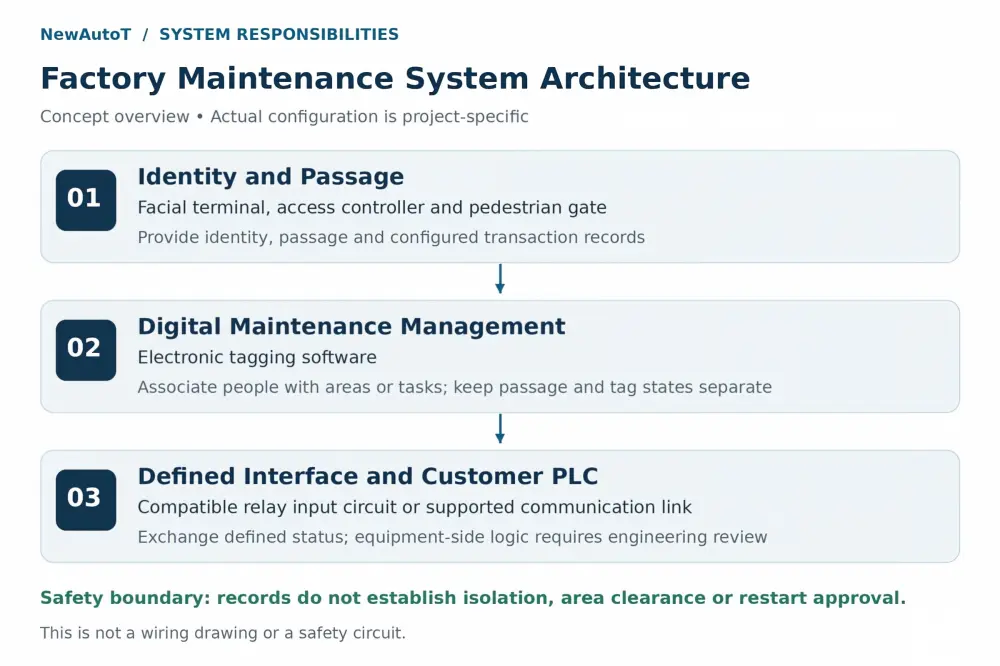
The solution combines several responsibilities. A facial recognition terminal identifies the operator using the selected identification method. An access controller and pedestrian gate manage passage permissions. The electronic tagging software maintains the configured maintenance records. A relay interface or supported communication connection exchanges defined information with the customer’s PLC or supervisory system.
NewAutoT’s industrial access control solutions can be reviewed around the entrance layout, maintenance workflow and existing control environment. The equipment list should identify which functions are handled inside the terminal, in an access controller, in the software or in the customer’s control cabinet. A device having a network connection does not establish that it can exchange every required data field.
A Maintenance Workflow from Identification to Record Closure
1 Identify the Worker and Confirm the Assignment
The worker identifies themselves at the configured terminal. The system checks the permissions relevant to that location and assignment. A successful facial match establishes identity within the configured recognition process; it does not establish training, work authorization or equipment safety unless those requirements are separately defined and checked.
2 Complete the Required Procedure and Register the Tag
Before entry into a hazardous maintenance area, responsible personnel must complete the site’s required shutdown, isolation, verification and authorization steps. Electronic tagging records the worker’s involvement at the point specified by the approved procedure. The software action must not be presented as evidence that physical isolation has occurred.
3 Grant Passage Only Under the Approved Conditions
The gate may release after the relevant access conditions have been met. For a general factory entrance, these may be personnel permissions and time rules. For a maintenance enclosure, the conditions and protective arrangements require a separate assessment. A standard pedestrian turnstile is not, by itself, a machine guard interlock or an energy isolation device.
4 Keep Passage Events and Tagging States Separate
During the work, the project may need to review who entered, who left and which maintenance tags remain active. These are different records. A worker leaving for tools may still have an active tag, while a missed exit transaction may leave the passage record incomplete. The design should preserve these distinctions and identify how discrepancies are investigated.
5 Reconcile Completion and Follow the Restart Procedure
After work, personnel complete the required departure and untagging steps. Supervisors reconcile outstanding tags, passage discrepancies and any required approvals. Equipment restart remains subject to the factory’s separate clearance and energy-restoration procedure. Closing the last digital tag must not automatically be treated as permission to restart.
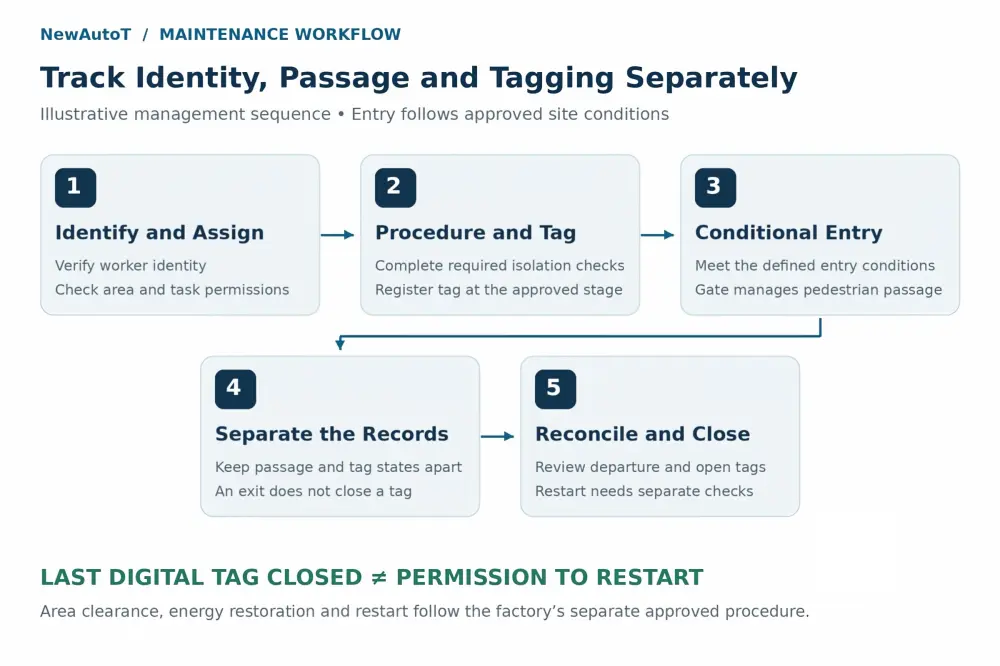
Illustrative management workflow. Entry conditions and restart decisions remain subject to the approved site procedure and engineered protective measures.
How Status Information Can Be Shared with a PLC
Relay Contacts and Digital Inputs
A relay dry contact can provide a switching state to a compatible PLC input circuit. For example, an agreed signal might indicate that the tagging application reports an active maintenance assignment. The signal name should describe exactly what it represents. A label such as “area safe” would imply much more than a maintenance record can establish.
Electrical engineers must confirm input voltage, contact ratings, isolation, normal and fault states, wiring and the response to loss of power. A relay contact does not supply identity details or a full event history. Those require a separate supported data connection when needed.
Communication Links and Protocol Compatibility
RS485 describes an electrical communication interface. A working connection also requires a shared protocol, compatible device roles and an agreed data map. Modbus RTU is one possible protocol only where both ends support it; it should not be promised merely because both devices have RS485 terminals. Network-based connections likewise require confirmed protocols, software support and fault handling.
Wiegand is generally associated with credential data between a reader and an access controller. It should not be described as a universal direct PLC connection. The integration design must specify any required controller, conversion module or decoding function. Prepare a signal list covering source, destination, meaning, update conditions, fault indication and reset or acknowledgement behavior before wiring begins.
Multiple Workers and Multiple Maintenance Areas
Consider two technicians assigned to the same production line. Each has a separate maintenance participation record. If one leaves the area to collect a tool, their exit event should not automatically remove their maintenance tag. When one technician completes their work and untags, the other technician’s record may remain active. This example illustrates why passage counts and tag counts cannot be substituted for one another.
Some projects request first-tag and last-untag status events. These should be defined as transitions in the agreed digital tagging state, rather than universal safety rules. The first active tag could trigger an informational maintenance-status update; the last tag closing could trigger a review notification. Neither event alone proves physical isolation or clearance.
For several work areas, assign distinct area and equipment identifiers. Define how one worker is associated with multiple assignments, how contractors are managed, and how shift handovers or exceptional removals are authorized. Any required feature must be included in the software scope and acceptance test. Matching entry and exit totals is useful for reconciliation, but cannot prove that nobody remains inside.
Information to Prepare Before Selecting Equipment
Start with the work-area layout, entrance dimensions, pedestrian routes and existing emergency exit arrangements. Identify whether the entrance is a general access point or part of a maintenance enclosure. Dust, moisture, lighting, PPE, mounting conditions and available power and network connections all affect equipment selection. Review suitable facial recognition terminals and pedestrian turnstiles against those conditions.
Provide the PLC brand and model, available I/O, electrical drawings and any supported communication protocols. Describe the maintenance process, required tagging records, number of areas and expected concurrent workers. Identify the requested software language, deployment arrangement and connections to other systems. Agree who supplies the cabinet, interface modules, installation, PLC programming and final safety validation. A short demonstration based on the customer’s own workflow is more useful than an unqualified compatibility claim.
Commissioning and Safety Responsibilities
Installation and maintenance work should include checking mounting, electrical connections and component condition against the equipment documentation. The site’s work procedures determine the isolation and access arrangements required for these activities.
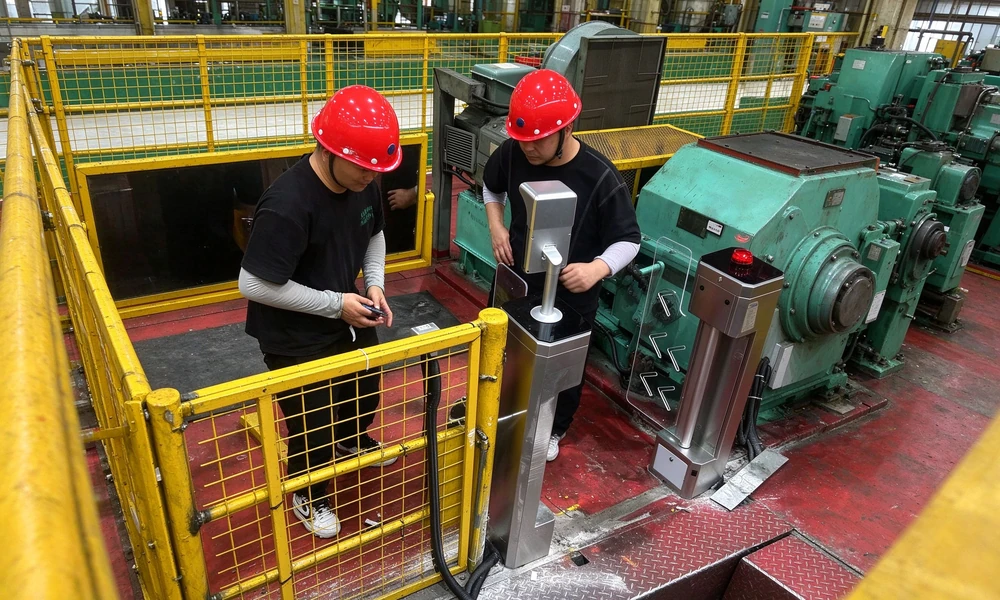
Acceptance testing should cover permissions, denied access, actual passage detection where fitted, tag creation and closure, duplicate transactions, overlapping assignments and discrepancies between records. Test power loss, network interruption, stale communication data and recovery. Define which records remain available offline and how synchronization is handled for the selected configuration; do not assume identical offline behavior across all devices and software modules.
Keep management functions distinct from engineered safety functions. OSHA’s guidance on energy control and control circuitry explains why control circuits and interlocking gates do not replace physical energy isolation under the US lockout/tagout framework. Applicable local requirements and the site’s risk assessment must guide each installation. Customer safety, electrical and automation personnel should approve isolation, clearance, machine protection and restart arrangements before commissioning.
Planning a NewAutoT Factory Maintenance Project
NewAutoT supplies facial recognition terminals, pedestrian turnstiles and electronic tagging software, with hardware customization and project interface support. A practical proposal should connect those capabilities to a defined maintenance process, selected equipment and an agreed software scope. It should also identify what the customer’s automation team or system integrator must implement.
To start, share your entrance layout, maintenance workflow, PLC model and required tagging operations. Contact NewAutoT to review your factory maintenance access and electronic tagging project. These details provide a basis for discussing suitable hardware, software configuration and integration responsibilities.
常见问题
What Is the Difference Between Factory Access Control and Electronic Tagging
Access control manages who may pass through an entrance. Electronic tagging records a person’s participation and status in a defined maintenance process. The two can be coordinated, but passage and tagging events remain separate records.
Can Electronic Tagging Replace Physical Lockout Tagout
Electronic records can support a maintenance process, but they do not by themselves provide physical energy isolation or replace required lockout/tagout measures. The installation must follow the site’s approved energy-control procedure and applicable requirements.
Can the System Connect to Our Existing PLC
Integration may be possible through compatible relay input circuits or supported communication links. Confirm the PLC model, electrical characteristics, protocol, signal meanings and software scope before finalizing the connection design.
Does the Last Worker Untagging Automatically Allow Restart
No. Closing the last digital tag is a record-state change. Personnel clearance, energy-restoration checks and the approved restart procedure remain separate requirements.
Does NewAutoT Provide the Electronic Tagging Software as Well as Hardware
Yes. NewAutoT provides electronic tagging software as well as facial recognition terminals and pedestrian turnstiles. The specific workflow, deployment, language and interface requirements should be confirmed in the project proposal.
What Should We Send for an Initial Project Review
Send a site layout or entrance photos, the maintenance workflow, number of areas and workers, PLC model, available interfaces and required tagging operations. Include software language and deployment requirements so the scope can be reviewed together.