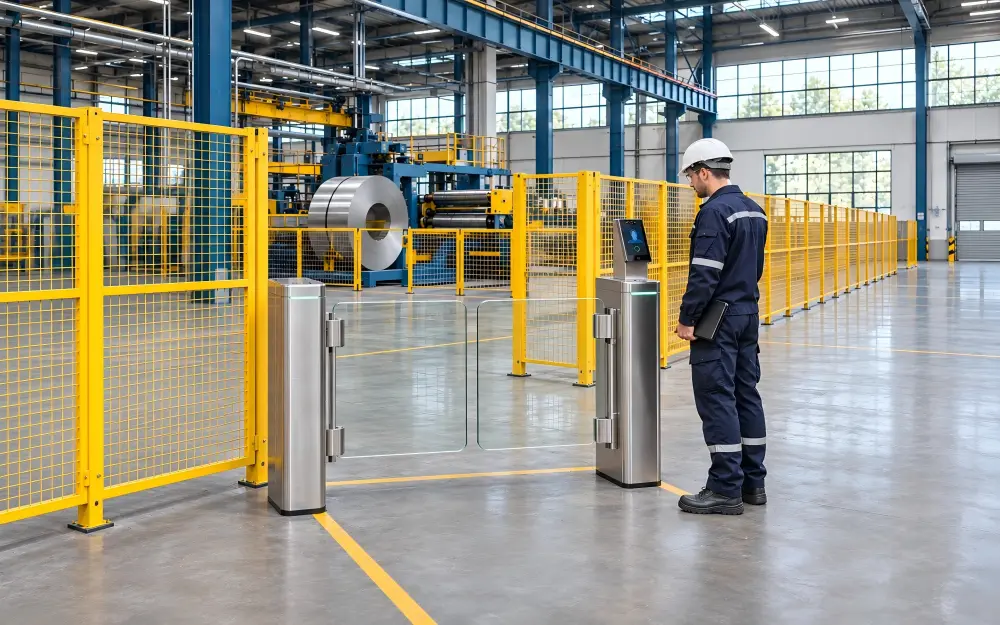


A factory maintenance safety system needs to do more than identify who is allowed through a gate. In an automated plant, maintenance teams must also coordinate work-area permissions, electronic tagging records, personnel movement and status information exchanged with existing controllers. These functions become especially important when multiple employees or contractors work across several production lines.
New Auto Element (NewAutoT) supplies facial recognition terminals, pedestrian turnstiles, project interface support and complete electronic safety tagging software. These components can be configured around customer-defined maintenance workflows and connected to an existing PLC or central control architecture through suitable, verified interfaces. The result is a coordinated management workflow—not a replacement for physical lockout/tagout (LOTO), energy isolation or safety-rated machine controls.
In brief: facial recognition establishes a user identity; electronic tagging software manages the configured tagging and untagging workflow; a pedestrian gate manages passage; and the customer’s PLC evaluates the signals and safety conditions required by its approved control design. Each component has a different responsibility.
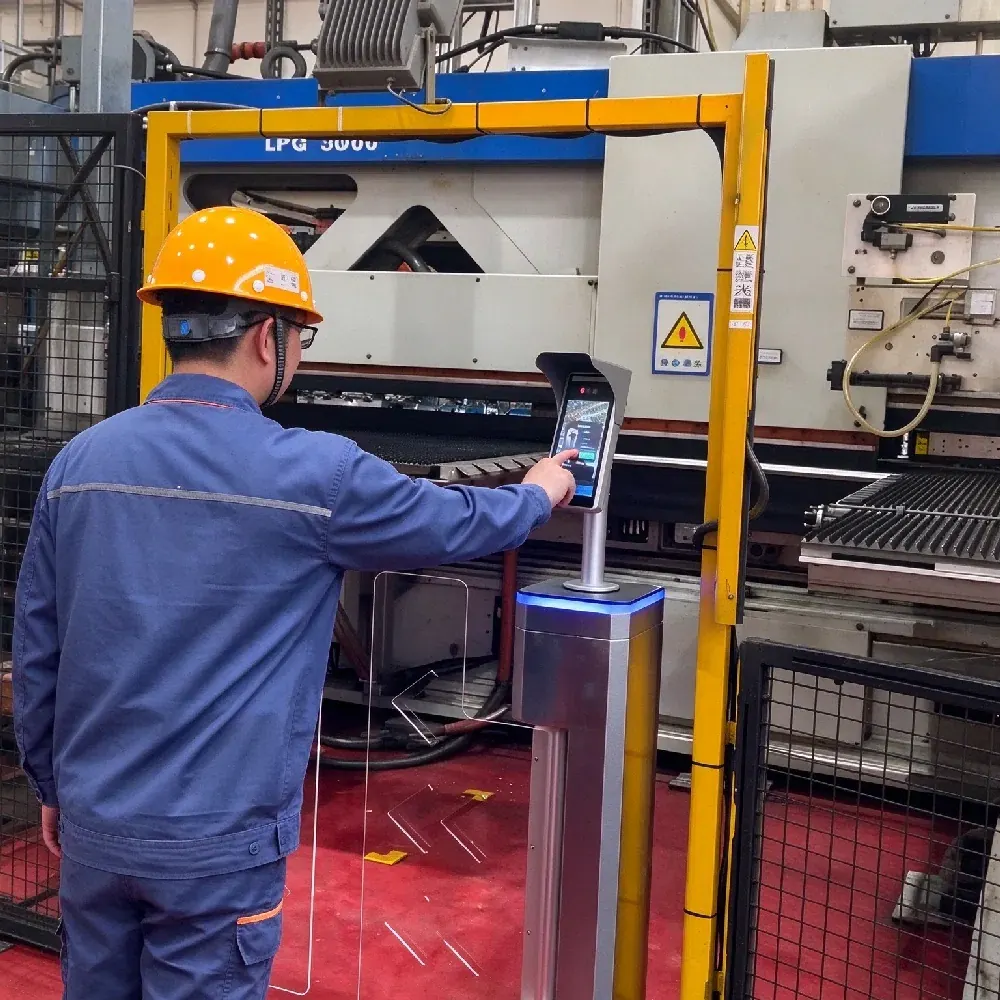
1. Why Traditional Factory Entry Records Are Not Enough
A conventional entrance system answers a narrow question: may this person enter? A factory maintenance team needs answers to several others: which production zone is involved, who is assigned to the job, which electronic tags remain active, whether a worker has completed the exit process, and what status information is available to supervisors. A paper register, a stand-alone gate and an independent maintenance log can each contain only part of the picture.
This fragmentation becomes more difficult during shift changes, contractor work and maintenance on equipment such as cutting machines, welding stations, slitting lines, conveyors or packaging machinery. A factory maintenance safety system can bring identity, zone permissions, event records and digital tagging workflows into a common management process while leaving safety-critical machine protection with the appropriate approved systems.
2. What NewAutoT Provides in an Integrated Project
The solution should be described as a combination of delivered software and selected hardware, rather than as a claim that every factory requires the same devices. NewAutoT provides complete electronic safety tagging software alongside facial recognition terminals, pedestrian gate hardware and interface support for project integration. The precise capabilities, protocol compatibility and custom development scope must be confirmed against the customer’s requirements and agreed configuration.
- Facial recognition terminals: verify registered personnel and support configured zone-based authorization.
- Electronic safety tagging software: manages configured equipment or area selection, tagging and untagging actions, user permissions, event history and status review.
- Pedestrian turnstiles: control entry and exit through designated passages when the project requires a physical lane.
- Interface and integration support: connects agreed non-safety status signals and events with controllers, relays and the existing automation environment.
- Optional project peripherals: status indicators, sound-and-light alarms and control cabinets, subject to the agreed bill of materials.
NewAutoT’s 产品中心 page is the starting point for reviewing terminal and pedestrian gate configurations. Project-specific mounting, wiring, software workflow and interface requirements can be discussed through its 服务支持 team.
3. How the Electronic Tagging Workflow Operates
The following sequence is an illustrative project workflow, not a universal machine safety sequence. It must be adapted to the site’s operating procedures, engineering assessment and software configuration.
Step 1 — Identify and authorize
A worker presents a registered identity at the terminal. The software or designated controller checks permissions for the relevant production line, maintenance zone or equipment group.
Step 2 — Create an electronic tag
The authorized worker selects the defined machine or area and completes the tagging action in the software. The system records the user, time and associated work area.
Step 3 — Control designated passage
Once project-defined administrative conditions are satisfied, a gate controller may receive an authorized passage command. Entry events are logged for reconciliation.
Step 4 — Record exit and untagging
After completing work and leaving the designated area, the worker follows the configured identity and untagging process. The software updates the event history and outstanding tagging status.
Step 5 — Review status and exceptions
Supervisors can review open tags, missing exit records and unresolved events. Agreed status information may be transmitted to the PLC; the PLC and validated safety system independently determine whether any equipment action is permitted.
For some projects, recorded entries (N1) and completed exits or untagging events (N2) can be compared. Equal counts are not proof that an area is clear or safe. Tailgating, missed reads, emergency egress, visitors, network interruptions and incorrect records require explicit exception procedures. No restart decision should rely on this count alone.
4. Factory PLC Integration: Define the Boundary Clearly
PLC integration is often the decisive engineering question for an industrial customer. Before specifying interfaces, the integrator should document which system verifies identity, which software holds tagging records, what controller authorizes the gate, what event or status data is exchanged, and what the existing machine control architecture does with those signals.
Depending on the selected terminal, controller and software configuration, a project may evaluate dry-contact relays, Wiegand, RS485 or other supported communications. Interface availability must be verified for each exact device model; no protocol should be assumed to exist across an entire product range. Network loss, power failure, duplicated commands, alarm conditions and manual recovery should be covered in the acceptance test plan.
Crucially, an ordinary access terminal, electronic tagging record or non-safety-rated relay must not be represented as a safety-rated interlock. The customer’s qualified automation and safety engineers remain responsible for risk assessment, energy isolation, protective devices and validated restart logic. For technical background, consult [OSHA’s control of hazardous energy guidance] and the ISO 13849-1 standard overview, subject to the regulations applicable to the project location.
5. Multi-Line and Multi-Zone Maintenance Management
A large factory may operate multiple lines with different personnel, equipment hazards and maintenance windows. NewAutoT’s electronic tagging software can be configured around project-defined areas and users, with the exact permissions and workflow rules agreed during implementation. A technician assigned to a packaging line, for example, should not automatically receive authorization for an unrelated welding cell.
Useful configuration questions include whether tags are assigned to equipment or areas, whether one person may hold multiple active assignments, how shift handovers are recorded, how contractor permissions expire, and how unresolved tags are escalated. These are software and process design decisions, not simply reader settings.
6. Installation Conditions and Real Factory Examples
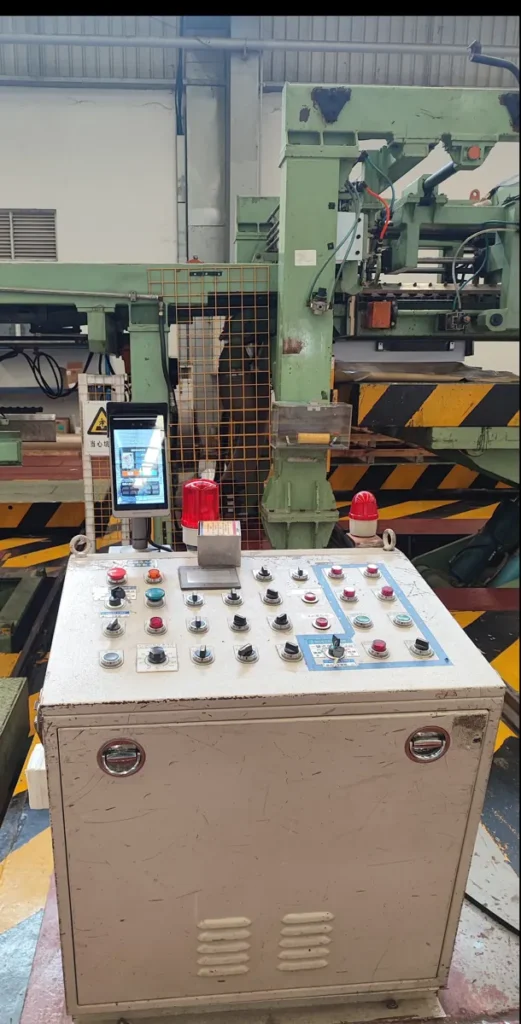
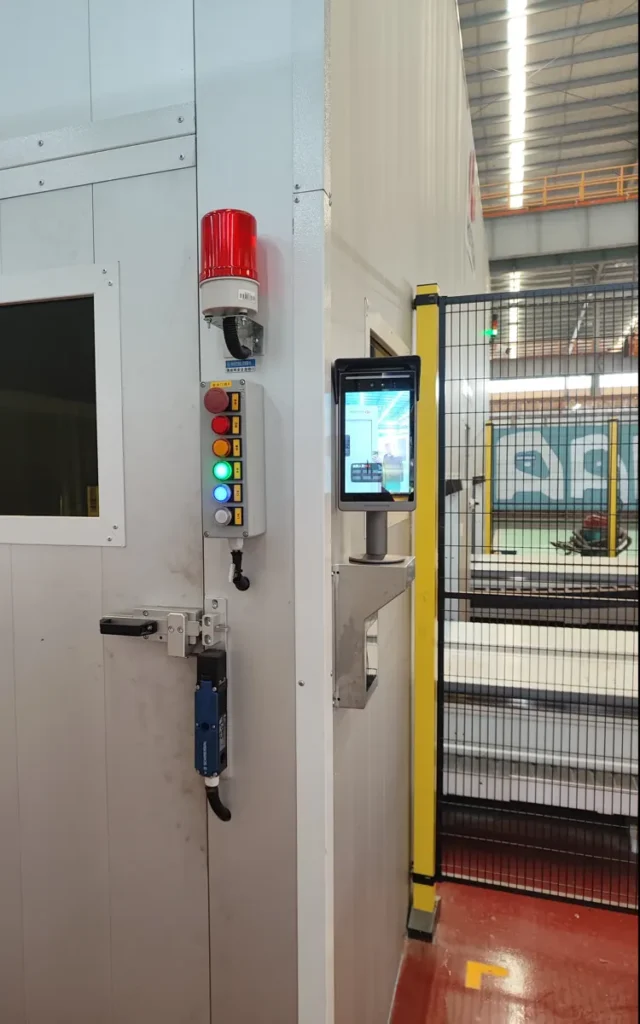
Industrial installation is constrained by more than the nominal dimensions of a turnstile. Integrators should review safe pedestrian routing, fencing, floor fixing, clear passage width, dust, moisture, vibration, lighting, power supply, network coverage and cable paths. Existing equipment guarding and emergency routes must remain compliant with the approved site design.
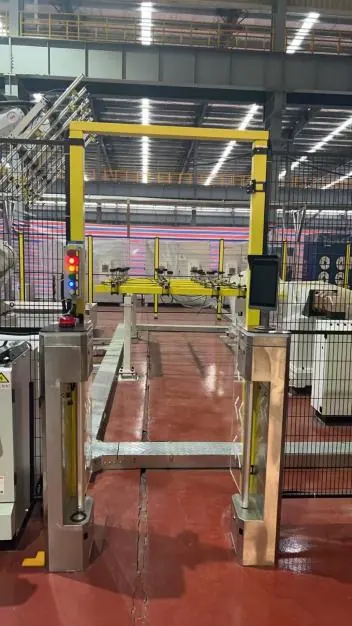
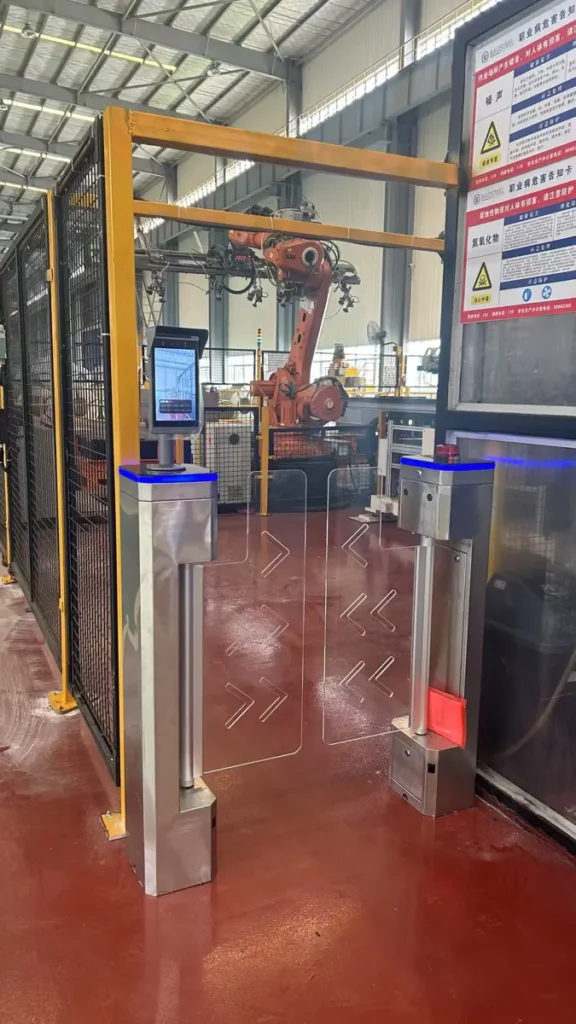
In other locations, a wall-mounted or stand-mounted facial recognition terminal may be more suitable than a full gate. Control cabinets and status alarms should be located where maintenance personnel can inspect them without entering a hazardous area.
7. Project Delivery, Customization and Commissioning
For system integrators and industrial buyers, a useful quotation should define what is supplied and what is developed or configured for the site. NewAutoT can discuss hardware selection, mounting arrangements, gate structures, terminal interfaces and the electronic safety tagging software workflow. PLC programming, safety-rated functions and third-party equipment changes should be assigned explicitly in the agreed scope of work.
- Site survey: identify production zones, entrances, equipment, existing controls and operating procedures.
- Requirements definition: specify users, tagging rules, exceptions, permissions, reporting needs and acceptance criteria.
- Interface review: confirm terminal model, PLC model, wiring, communication and non-safety status signals.
- Software configuration: set up equipment areas, personnel roles, electronic tagging and untagging workflows.
- Installation and integration: deploy the selected devices, cabling, control cabinets and software components.
- Commissioning: test normal operations, invalid credentials, unfinished tags, network loss, power recovery and emergency conditions.
- Handover: provide approved procedures, training, responsibility assignments and maintenance documentation.
A project should also define data retention, authorized administrators, access to biometric information and any privacy requirements that apply to the deployment. Where face recognition is used, an alternative process may be necessary for users who cannot or should not use biometric verification.
8. What Benefits Can a Factory Expect?
The main potential benefits are clearer records and more coordinated workflows: identifiable personnel events, configurable zone permissions, visible outstanding electronic tags, less dependence on disconnected paper logs and a documented interface between entry management and the factory’s existing systems. These are operational possibilities, not guaranteed reductions in incidents or downtime; measurable results depend on the site design and implementation.
For OEM/ODM and system-integration partners, the commercial advantage is the ability to evaluate hardware and tagging software together. A buyer can specify the physical entrance, terminal mounting and digital maintenance workflow as parts of one project rather than sourcing every element independently.
9. Essential Safety Limitations
Electronic safety tagging software supports administrative workflow, identity records and status coordination. It does not substitute for approved lockout/tagout procedures, personal locks, physical energy isolation, verification of a zero-energy state, emergency stops or validated machine safety functions. A successful facial recognition match, equal entry and exit counts or a single status signal must never be treated as sufficient evidence that machinery can restart.
All shutdown, isolation and restart decisions must follow the customer’s risk assessment, qualified engineering review, applicable regulations and approved operating procedures. Any safety-related control function must use appropriately designed and validated safety components.
10. Request a Factory Maintenance Integration Assessment
If you are planning a factory maintenance safety system, send NewAutoT your plant layout, number of controlled entrances, production zones, required electronic tagging workflow, terminal mounting preferences, PLC brand/model and available interface documentation. The team can discuss a suitable combination of facial recognition terminals, pedestrian gates, electronic safety tagging software and project interface support.
Discuss your requirements through the NewAutoT Contact page or review AI Access Control Solution for the wider solution context.
常见问题
Does NewAutoT supply electronic safety tagging software or only hardware?
NewAutoT supplies complete electronic safety tagging software as well as facial recognition terminals, pedestrian gate hardware and project interface support. Specific workflows and integrations are confirmed during project scoping.
Can electronic tagging software work with an existing factory PLC?
Potentially, through supported interfaces and an agreed control architecture. The exact PLC model, signals, software configuration and responsibilities must be verified before installation.
Does electronic tagging replace physical lockout/tagout?
No. Electronic tagging is an administrative and record-management aid. Required energy isolation, personal locks, verification and validated machine safety controls remain essential.
What happens when a worker forgets to untag?
The project should define an unresolved-tag workflow, supervisor review, audit records and a controlled exception process. A missing untagging event must not be bypassed by assuming that personnel counts are sufficient.
Can the software manage several production lines?
The system can be configured around project-defined zones, equipment groups, user roles and tagging points, subject to the agreed requirements and software scope.
Which pedestrian gate is best for a factory?
The choice depends on available space, traffic, site conditions, required passage width and emergency egress. A site survey is recommended before selecting a swing gate, speed gate or tripod turnstile.
Can the system record who entered and exited a maintenance area?
Configured terminal and gate events can support personnel entry and exit records. These records must be reconciled with exception handling and must not be used as sole proof of area safety.
What information should buyers send for an integration quotation?
Provide plant and entrance drawings, required workflow, number of users and zones, PLC model, available interfaces, site environment and expected installation schedule.